Design and Construction
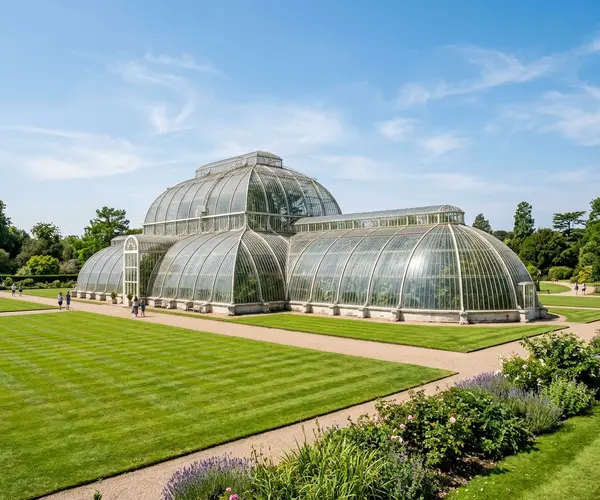
The Palm House at Kew Gardens was built between 1844 and 1848 to house the growing collection of tropical plants that Kew had been acquiring from expeditions around the world. It was designed by Decimus Burton, one of the leading architects of the period, in collaboration with the Irish ironworker Richard Turner, who engineered the structural framework.
The building's distinctive curved profile was revolutionary for its time. Rather than using traditional straight-sided construction, Burton and Turner created a hull-shaped structure using wrought iron ribs and 16,000 panes of glass. The curved design was not purely aesthetic. It allowed maximum light penetration and created natural convection currents that helped regulate the internal climate without mechanical systems.
The Palm House was one of the first major buildings in the world to use wrought iron as a primary structural material, predating the Crystal Palace by several years. Its engineering influenced a generation of subsequent glasshouse and exhibition hall designs across Europe.
Inside the Palm House
Stepping inside the Palm House is like walking into a tropical rainforest. The temperature is maintained at around 26 degrees Celsius with high humidity, creating the conditions needed for plants that originate from equatorial regions. The atmosphere hits you immediately, particularly on cooler days when the contrast with the outside air is dramatic.
The planting is arranged on multiple levels. At ground level, palms, cycads and tropical ferns grow in dense beds, some reaching almost to the roof. A wrought iron spiral staircase leads to a raised gallery walkway that runs around the upper level, putting you at canopy height among the tallest plants. From up here you can appreciate both the scale of the planting and the elegance of the ironwork structure.
The collection includes plants from every major tropical region. There are coconut palms, banana plants, rubber trees, cacao and coffee plants, mangroves and dozens of species of tropical fern. Several of the specimens are extremely old, having been growing in the Palm House for over a century.
The Marine Display
Beneath the Palm House, accessed by a staircase at the western end, is a marine display featuring aquariums with tropical fish, corals and other marine organisms. This below-ground level takes advantage of the Palm House's heated foundations and provides a cool contrast to the tropical heat above. The tanks contain species from coral reefs and coastal waters, linking to Kew's broader research into aquatic plant ecosystems.
History and Restoration
When the Palm House opened in 1848, it was the most advanced horticultural building in the world. It allowed Kew's botanists to grow and study tropical plants that could never survive in the British climate, supporting research into species from the expanding British Empire.
The building has undergone several major restorations. The most significant was between 1984 and 1988, when the entire structure was dismantled, the ironwork was repaired and treated, and all 16,000 glass panes were replaced. The plants were temporarily rehomed and then replanted after the restoration, which preserved the original design while addressing structural corrosion that had accumulated over 140 years.
Visiting the Palm House
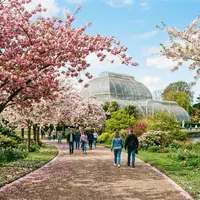
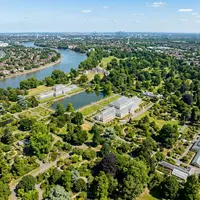
The Palm House sits at the heart of Kew Gardens, facing the ornamental pond and the parterre garden. It is usually the first major building visitors encounter when entering from the Victoria Gate. There is no additional charge to enter, as it is included with garden admission. The Palm House is just one highlight across the 300-acre UNESCO World Heritage Site.
On hot summer days the interior can become uncomfortably warm, as the tropical heating combined with solar gain pushes temperatures well above 30 degrees. The most pleasant times to visit are morning or late afternoon, or on cooler days when the contrast between outside and inside is refreshing rather than overwhelming.