Frensham Great Pond
A medieval freshwater lake with sandy beach and wild heathland — Surrey's favourite open-water swimming spot
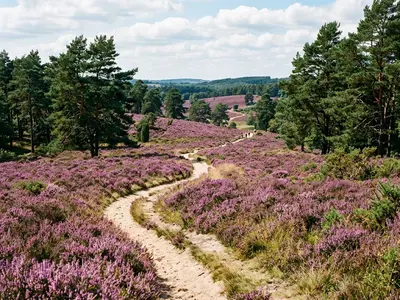
A medieval freshwater lake with sandy beach and wild heathland — Surrey's favourite open-water swimming spot
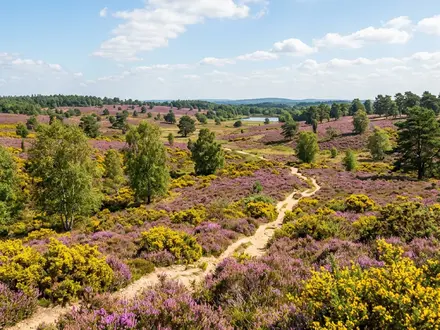
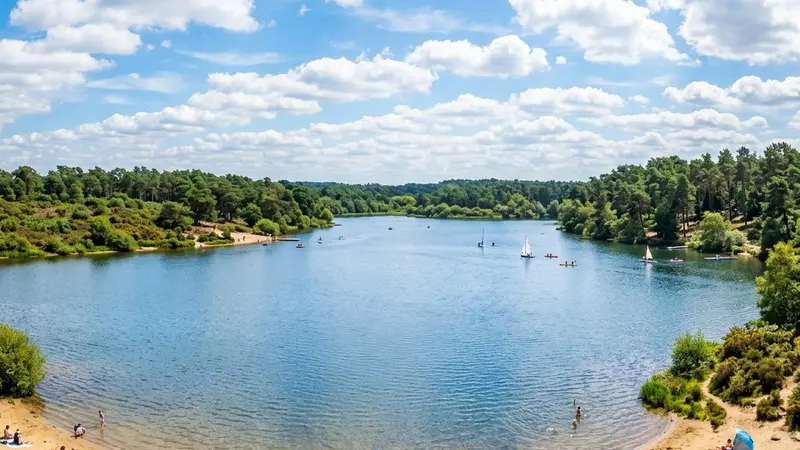
Frensham Great Pond covers over 100 acres of freshwater in the Surrey Hills, making it one of the largest bodies of inland water in southern England. Created in the 13th century to supply fish to the Bishop of Winchester at nearby Farnham Castle, the pond sits within Frensham Common, a 922-acre expanse of lowland heathland that is a Site of Special Scientific Interest, a Special Protection Area and a Special Area of Conservation.
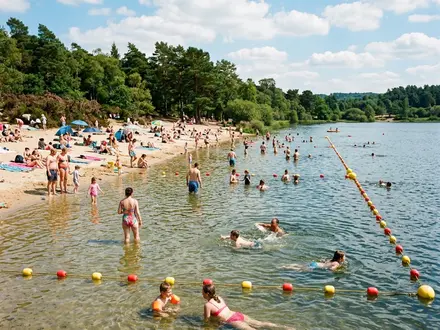
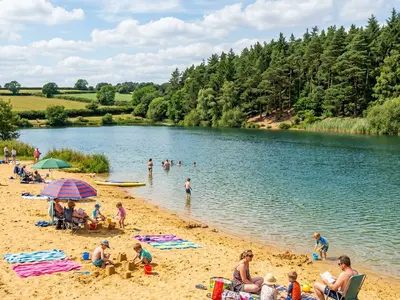
The pond's sandy beach draws swimmers throughout summer, with two designated bathing areas marked by buoys. A lakeside cafe and public toilets are open during the season. The surrounding common is home to rare heathland birds including Dartford warblers, woodlarks and nightjars, and the network of paths offers miles of walking through heather, gorse and scattered pine woodland.
Frensham Great Pond owes its existence to the medieval appetite of the Bishop of Winchester. In 1246, when the bishop needed a reliable supply of fresh fish for his household during visits to Farnham Castle, his engineers dammed a tributary of the River Wey to flood a natural hollow in the sandy heathland. The resulting lake eventually grew to cover more than 100 acres, making it one of the largest inland bodies of water in south-east England. A second, smaller pond was created nearby for the same purpose, and together they have shaped this landscape for nearly eight centuries.
The ponds played an unexpected role in the Second World War. Both were deliberately drained so that German bomber pilots, navigating by landmarks on moonlit nights, could not use the large reflective surfaces to orient themselves on raids towards Portsmouth and Southampton. The ponds were refilled after the war, and the common gradually returned to its heathland character.
The sandy beach is the main draw during warmer months. A broad crescent of golden sand shelves gently into the water, creating shallow paddling areas for young children and two roped-off swimming zones where the depth reaches around 1.4 metres. Swimming is free but unsupervised, so visitors should take care, particularly after heavy rain when visibility drops. A seasonal cafe beside the car park serves hot drinks, snacks and ice cream, and public toilets including accessible facilities are open during the main season.
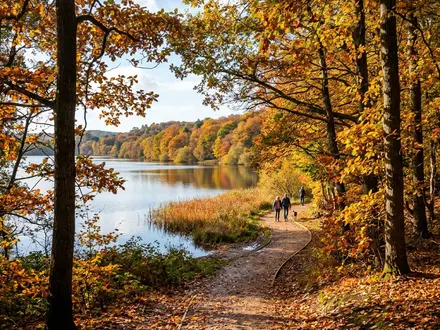
Beyond the beach, Frensham Common offers some of the finest lowland heathland walking in Surrey. The circular route around the Great Pond takes roughly an hour and passes through pine woodland, open heath and along the water's edge. For a longer outing, the path north to Frensham Little Pond and back adds another hour and crosses higher ground with views across the common. The most ambitious route follows the ridge to the Devil's Jumps, a chain of seven prominent Bronze Age burial mounds visible for miles around.
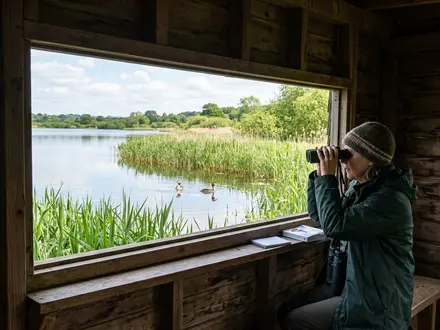
The common is an outstanding site for wildlife. All six native British reptile species live here, including the rare sand lizard and smooth snake. Birdwatchers come for the Dartford warblers that flit through the gorse, the woodlarks that sing from treetops in spring, and the nightjars whose churring call fills summer evenings at dusk. On the water, great crested grebes perform their elaborate courtship dances in spring, while cormorants perch on dead trees along the far shore.
Frensham Great Pond sits on the A287 between Farnham and Hindhead, within the Surrey Hills Area of Outstanding Natural Beauty. The drive from central London takes around 90 minutes via the A3 and A31, though traffic through Guildford can add time at weekends. The car park on Bacon Lane fills very early on warm summer days, often by 10am, so arriving first thing is strongly recommended.
By public transport, Farnham is the nearest railhead with regular services from London Waterloo. The Stagecoach 19 bus connects the station with the pond on an hourly basis Monday to Saturday. There is no Sunday bus service, making a taxi from Farnham the most practical option at weekends.
The surrounding area offers plenty to combine with a visit. The market town of Farnham, three miles north, has a handsome Georgian high street, a castle and a strong selection of pubs and cafes. The Sculpture Park at Churt is less than two miles away and makes a good pairing for a quieter afternoon. Hindhead Common and the Devil's Punch Bowl, a dramatic National Trust landscape, lie four miles to the south along the A287.
Entry is completely free. Parking charges apply on Saturdays, Sundays and bank holidays from Easter to the end of September, payable by RingGo or card only. National Trust members park free. No cash payments accepted.
The car park fills extremely early on warm weekends and bank holidays. If you arrive after 10am you will likely find it full with no overflow parking available. Early morning is also the best time for a peaceful swim.
Weekend and bank holiday parking is payable by RingGo app or card only. No cash machines or coin meters are available on site. Download the app and register your card before you travel to avoid delays.
The seasonal cafe is small and queues build quickly on busy days. There are no other shops within walking distance. Pack a picnic and plenty of water, especially if you plan to swim and walk.
The sandy trails across the common are uneven in places and can be muddy after rain. Flip-flops are fine for the beach but walking boots or sturdy trainers are better for exploring the wider common.
Swimming is unsupervised and at your own risk. Waverley Borough Council posts water quality notices at the beach. Avoid swimming after heavy rainfall when run-off can temporarily affect water quality.

London Travel Writer · 12+ years covering UK attractions and tourism
Last reviewed: March 10, 2026