Dapdune Wharf
A restored National Trust wharf on the River Wey — historic barges, boat trips and canal heritage in Guildford
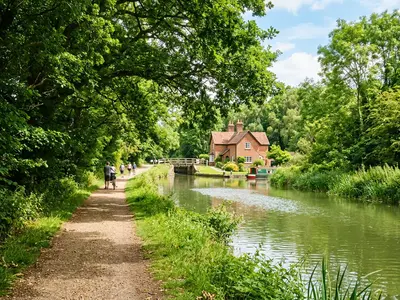
A restored National Trust wharf on the River Wey — historic barges, boat trips and canal heritage in Guildford
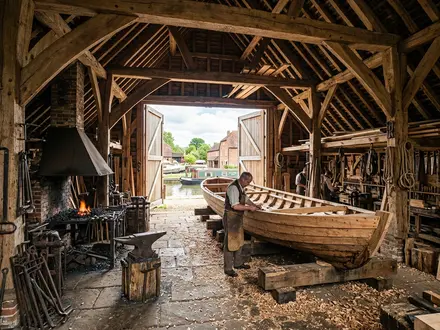
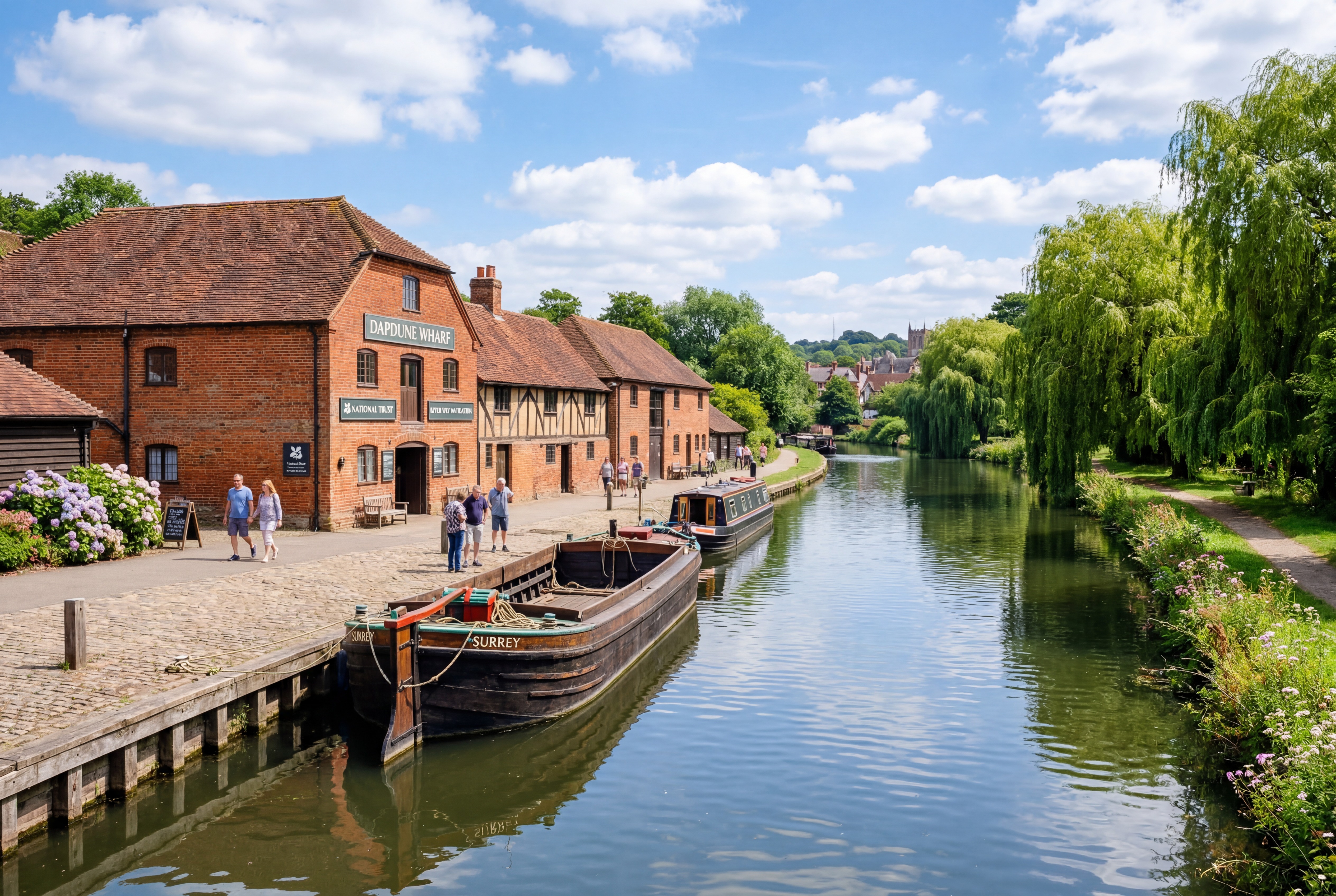
Dapdune Wharf sits on the banks of the River Wey Navigation in Guildford, a waterway that has carried cargo between Surrey and the Thames since the 1650s. Managed by the National Trust, the wharf tells the story of one of England's earliest canal systems through interactive exhibits, restored buildings and the chance to climb aboard a full-sized Wey barge. The site was once the centre of barge building on the navigation, and the workshops and slipway where wooden barges were constructed and launched still stand today.
Visitors can take a 40-minute boat trip along the navigation, explore the blacksmith's forge and stable block, and learn how families lived and worked on the waterway for over three centuries. The surrounding towpath offers gentle walks along the river into Guildford town centre or out towards the Surrey countryside, making Dapdune Wharf both a destination in its own right and a starting point for exploring the Wey valley.
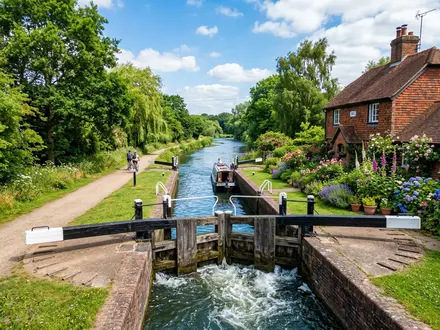
The River Wey Navigation owes its existence to Sir Richard Weston, a local landowner who saw the commercial potential of linking Guildford to the Thames. Work began in 1635 and the navigation opened in 1653, one of the earliest artificial waterways in England. Twelve locks were built to carry barges the 15 miles from Guildford to the Thames at Weybridge, and for over three centuries the waterway transported timber, flour, gunpowder and agricultural goods between Surrey and London.
Dapdune Wharf grew into the busiest yard on the navigation during the nineteenth and early twentieth centuries. The Stevens family, and later the Edwards family, built and repaired the sturdy wooden barges that worked the waterway. The large barge-building shed, the blacksmith's forge where ironwork was shaped, and the stable block where tow horses rested between shifts all survive. In 1964, the navigation's private owner Harry Stevens gave the entire waterway to the National Trust, making it the first inland waterway the Trust ever managed. Commercial traffic continued until 1983, when the last working barge made its final run.
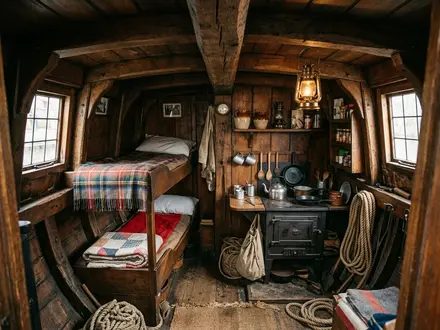
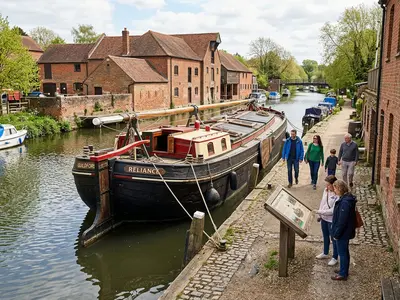
The star exhibit is the Reliance, a 72-foot Wey barge built at Dapdune in 1932. Visitors can climb aboard and duck into the tiny living quarters where bargemen slept, cooked and spent weeks at a time during cargo runs to London. The Reliance has a remarkable story of her own — she sank near Canons Street Bridge in 1968 and was abandoned, only to be rediscovered 21 years later beached at Leigh-on-Sea in Essex. A six-month restoration brought her back to the wharf where she was built.
Beyond the barge, the wharf buildings house interactive displays explaining how the navigation worked, how locks were operated and how families made their living on the water. Children can try their hand at loading a model barge, dressing up in bargee clothing and operating a lock mechanism. The forge, stable and barge shed are open to explore, with volunteer guides often on hand to answer questions.
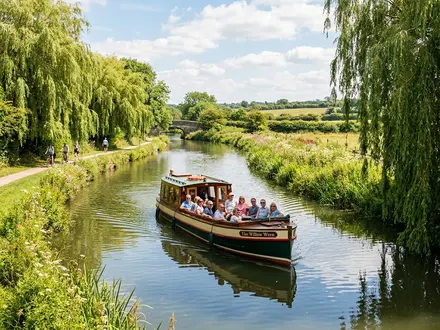
The boat trips are the highlight for many visitors. A 40-minute cruise departs six times daily from Thursday to Monday between March and October, gliding past overhanging willows, riverside gardens and open meadows. Volunteer skippers share stories of the waterway's working history as you drift along one of the prettiest stretches of the navigation.
The Wey Navigation towpath runs 20 miles from Godalming to the Thames at Weybridge, and Dapdune Wharf makes an ideal starting point. Walk south for ten minutes to reach Guildford town centre, passing under the medieval Town Bridge and alongside the Yvonne Arnaud Theatre. Head north and the path follows the river through water meadows and quiet woodland towards Send and Pyrford, passing lock-keepers' cottages and weirs along the way.
The towpath is flat, well-maintained and largely surfaced, making it accessible for pushchairs and many wheelchair users. Cyclists share the route, which forms part of the National Cycle Network. For a longer outing, the full walk from Guildford to Weybridge takes around five hours and finishes near Weybridge station for a train back.
Dapdune Wharf is tucked behind Woodbridge Road, just north of Guildford town centre. The postcode GU1 4RR brings you to Wharf Road. On-site parking is limited, and on busy days during summer the car park fills early. National Trust members park free; non-members pay via the JustPark app.
Guildford station is a 15-minute walk away, with regular services from London Waterloo taking about 35 minutes. The walk from the station passes through the attractive high street with its cobbled hill and the Guildhall clock overhanging the pavement.
The wharf combines well with other Guildford attractions. The castle keep and grounds are a short walk into the town centre, and Guildford Cathedral sits on Stag Hill to the west. For more National Trust properties, Clandon Park and Hatchlands Park are both within a 15-minute drive. The towpath itself connects to Shalford, Godalming and eventually the Thames Path for walkers looking to extend their day.
Entry to Dapdune Wharf and the exhibits is completely free. National Trust members park free. Boat trips must be booked in advance and are charged to both members and non-members. Children under one year travel free. Parking is payable via the JustPark app only.
Boat trips are very popular and often sell out, especially during school holidays and sunny weekends. Book online through the National Trust website to guarantee your place on a specific departure.
The riverside walk from Dapdune Wharf into Guildford town centre takes only ten minutes and is a lovely way to extend your visit. Head north for a longer walk through water meadows.
There is no cafe at Dapdune Wharf itself, though you will find plenty of options in Guildford town centre nearby. The grassy areas beside the river are perfect for a picnic on a sunny day.
Dapdune Wharf is open Thursday to Monday from March to October. It is closed during winter months though the towpath remains open year-round for walking and cycling.
On-site parking is limited and payable via the JustPark app only. Download the app and register a payment method before you arrive. National Trust members park free with a valid membership card.

London Travel Writer · 12+ years covering UK attractions and tourism
Last reviewed: March 10, 2026