Crystal Palace Park Dinosaurs
The world's first life-size dinosaur sculptures — 29 Victorian prehistoric beasts set on islands in a south London park since 1854
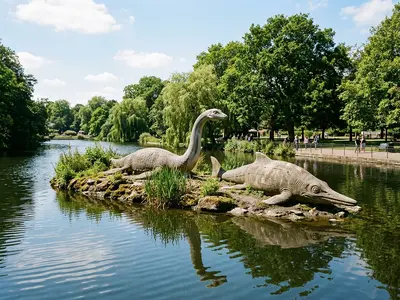
The world's first life-size dinosaur sculptures — 29 Victorian prehistoric beasts set on islands in a south London park since 1854
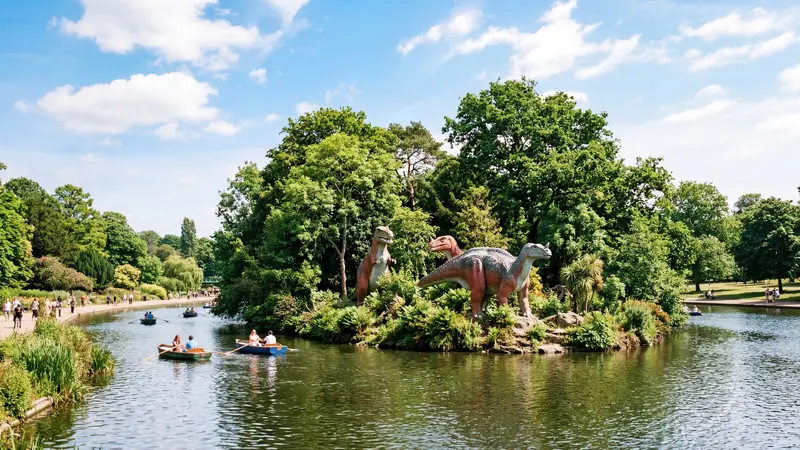
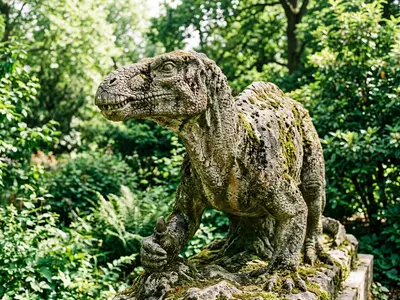
In 1854, sculptor Benjamin Waterhouse Hawkins unveiled 33 life-size prehistoric animal models on a series of islands in Crystal Palace Park — the first attempt anywhere in the world to reconstruct dinosaurs at full scale. Twenty-nine of those original sculptures survive today, each one a Grade I listed structure and a remarkable time capsule of early Victorian palaeontology.
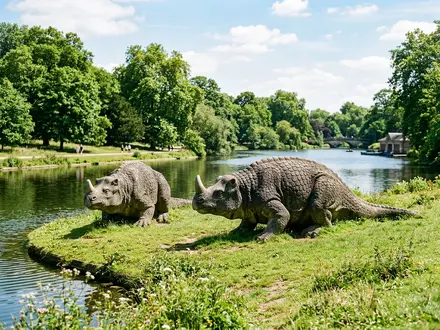
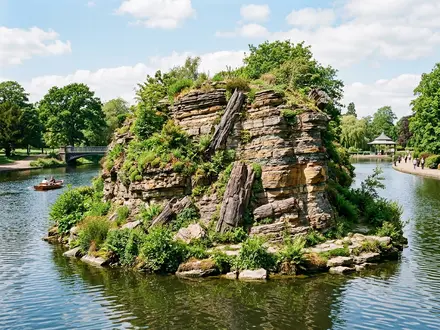
The models sit on landscaped islands in the park's lower lake, surrounded by geological layers designed to illustrate the earth's history. You can walk the full circuit on foot, spotting Iguanodons, Ichthyosaurs, Megalosaurs and ancient mammals arranged in their reconstructed habitats among mature trees and waterways.
Crystal Palace Park's dinosaur sculptures were commissioned in 1852, two years after Joseph Paxton's Crystal Palace was relocated from Hyde Park to Sydenham Hill. The sculptor Benjamin Waterhouse Hawkins worked under the scientific direction of Sir Richard Owen, the anatomist who had coined the word "dinosauria" just a decade earlier. Together, they set out to create the world's first life-size reconstructions of extinct animals, using the limited fossil evidence available at the time.
The models were unveiled on 10 June 1854 to enormous public interest. Arranged on purpose-built islands in an artificial lake, with geological strata layered to illustrate the earth's history, they formed one of the earliest examples of science communication aimed at a general audience. Though many of the reconstructions are now known to be inaccurate — the Iguanodons walk on four legs and sport nose horns that are actually thumb spikes — they remain an extraordinary record of mid-Victorian scientific understanding.
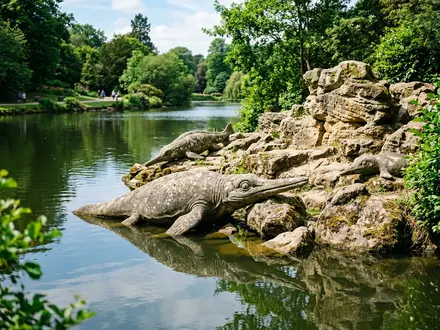
Twenty-nine sculptures survive from the original 33, spread across several islands in the park's lower lake. The collection includes not just dinosaurs but also Ichthyosaurs, Plesiosaurs, Pterodactyls, ancient mammals and amphibians, arranged in rough chronological order through geological time. Each island represents a different era, with appropriate rock formations and planting.
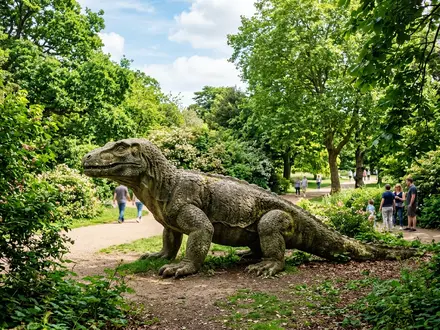
The Iguanodons are the most recognisable, their bulky forms visible from several vantage points around the lake. The marine reptiles on their own island are among the most scientifically sound reconstructions, while the Megalosaurus crouching on all fours reflects a now-outdated view of how theropod dinosaurs moved. Information boards around the circuit explain both what Hawkins got right and where modern science has moved on.
The wider park offers plenty more — a boating lake, a maze, Italian terraces with views across south London, and the remains of the Crystal Palace foundations. The National Sports Centre sits at the top of the park, and a farmers' market runs on Saturdays.
The park has several cafes, including one near the Penge Gate entrance close to the dinosaurs. Public toilets and a car park are also available at the Thicket Road entrance. The dinosaur trail is pushchair-friendly, though some paths near the lake can be muddy after rain.
Crystal Palace itself is a lively neighbourhood with independent restaurants, pubs and shops along Westow Street and the Triangle. The Horniman Museum and Gardens in neighbouring Forest Hill is roughly 20 minutes on foot or a short bus ride away, offering free entry to its natural history collections — a fitting companion to the dinosaurs.
Crystal Palace Park and the dinosaur sculptures are completely free to visit year-round with no booking required
The Penge Gate entrance on Thicket Road puts you closest to the dinosaur islands. The Crystal Palace station entrance is at the opposite end of the park and adds 10 minutes.
The dinosaurs are outdoors with no shelter, so wet weather clears the crowds. Paths can be muddy near the lake, so wear sturdy shoes and you will likely have the place to yourself.
Some sculptures sit on islands in the middle of the lake and cannot be reached on foot. Binoculars or a zoom lens help you see the finer details of the marine reptile models.
The free Horniman Museum in Forest Hill is 20 minutes on foot or a short bus ride away. Its natural history gallery pairs well with the dinosaurs for a full day out.
The sculptures undergo periodic conservation work. Some models may be fenced off or obscured by scaffolding. Check the Friends of Crystal Palace Dinosaurs website for updates.

London Travel Writer · 12+ years covering UK attractions and tourism
Last reviewed: June 2, 2026