Manet's A Bar at the Folies-Bergere
The single most famous painting at the Courtauld Gallery is Edouard Manet's A Bar at the Folies-Bergere, completed in 1882, the year before the artist's death. It shows a barmaid standing behind a marble counter laden with bottles of champagne, beer and fruit, with the reflection of the crowded bar visible in the mirror behind her.
The painting is endlessly discussed by art historians because the reflection does not match what we see. The barmaid's reflection is displaced to the right, and the figure she appears to be serving is not visible from the viewer's position. Whether this was a deliberate ambiguity, a comment on the nature of perception or simply an artistic liberty remains debated. What is not debated is the painting's power. The barmaid's expression, somewhere between boredom and melancholy, is one of the most memorable faces in art.
Van Gogh's Self-Portrait with Bandaged Ear
Vincent van Gogh painted this self-portrait in January 1889, shortly after the incident in which he severed part of his own ear. He appears calm and composed, wearing a fur hat and a green coat, with a white bandage wrapped around his head. A Japanese print is visible on the wall behind him, a reference to the Japanese art that profoundly influenced his work.
The painting is remarkable for its restraint. Given the circumstances in which it was made, you might expect something turbulent, but Van Gogh presents himself with quiet dignity. The brushwork is controlled, the colours are muted and the overall impression is of a man determined to continue working despite everything.
Cezanne's Card Players
Paul Cezanne painted several versions of The Card Players during the 1890s, and the Courtauld's version is one of the most important. It shows two men absorbed in their game, their bodies reduced to solid geometric forms. The painting demonstrates the structural approach to composition that would influence the development of Cubism and much of 20th-century art.
The Courtauld holds an exceptional collection of Cezanne's work, including landscapes, still lifes and figure paintings. Seeing several Cezannes together gives a better understanding of his methods than seeing individual works scattered across different galleries.
Other Essential Works
Renoir's La Loge shows a woman at the theatre, her companion leaning back to scan the audience with opera glasses. It is a sparkling, elegant painting that captures the social rituals of Parisian cultural life in the 1870s.
Degas contributed several important works to the collection, including his studies of dancers and his portraits. Monet's Autumn Effect at Argenteuil and other landscapes show the Impressionist technique at its most refined, with light and colour dissolving solid forms into shimmering surfaces.
Beyond Impressionism
The collection extends well beyond the Impressionist period. Medieval and Renaissance paintings, including works by Cranach and Rubens, provide historical depth. Early 20th-century works by artists including Kandinsky, Modigliani and the Bloomsbury Group painters show how the ideas pioneered by the Impressionists developed over the following decades.
Why the Collection Matters
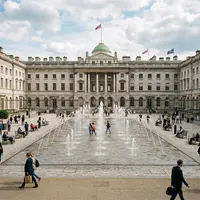
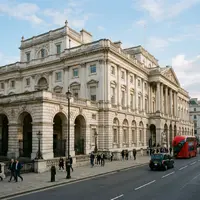
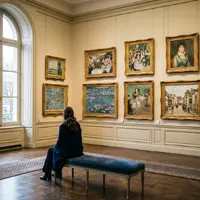
The Courtauld's collection is relatively small compared to the National Gallery or Tate, but its quality per square metre is arguably unmatched. The Impressionist and Post-Impressionist holdings in particular represent one of the most concentrated displays of artistic genius anywhere in the world. The intimate scale of the gallery, housed in the elegant rooms of Somerset House, means that you can stand close to masterpieces that would be roped off or crowded in larger institutions, creating a more personal and rewarding viewing experience.