The Crypt
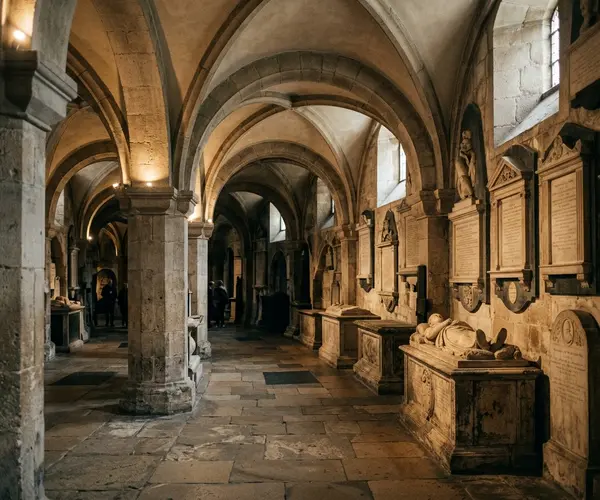
The crypt of St Paul's Cathedral stretches beneath the entire length of the building and is the largest crypt in Europe. It contains the remains and memorials of some of the most significant figures in British history, spanning military leaders, scientists, artists, writers, and the architect who designed the cathedral itself.
Unlike Westminster Abbey, where tombs and memorials compete for space in every available corner, St Paul's crypt has a more measured layout. The principal tombs occupy prominent positions, surrounded by marble sarcophagi, statues, and inscribed tablets that record the achievements of those honoured here.
Military Heroes
The Duke of Wellington
Arthur Wellesley, the 1st Duke of Wellington, received one of the grandest funerals in British history when he died in 1852. His tomb occupies a central position in the crypt, beneath a massive Cornish porphyry sarcophagus that rests on a granite base. Wellington defeated Napoleon at Waterloo in 1815 and later served as Prime Minister. His funeral procession drew over a million people to the streets of London.
Admiral Lord Nelson
Horatio Nelson's tomb sits directly beneath the centre of the dome, the most prominent position in the cathedral. He was killed at the Battle of Trafalgar in 1805, and his body was preserved in a cask of brandy for the voyage home. His coffin was made from the mast timber of the French ship L'Orient and sits inside a black marble sarcophagus originally commissioned by Cardinal Wolsey in the 16th century.
Scientists and Medical Pioneers
Alexander Fleming
The discoverer of penicillin, who died in 1955, is memorialised in the crypt. His accidental discovery in 1928 transformed medicine and has saved countless millions of lives. Fleming shared the Nobel Prize in Physiology or Medicine in 1945.
Florence Nightingale
The founder of modern nursing does not have a tomb at St Paul's but is honoured with a memorial. She died in 1910, and her family declined the offer of a burial in the cathedral, choosing instead a simple family grave in Hampshire, as she had wished. Her memorial at St Paul's recognises her transformation of nursing practice and hospital sanitation.
The Architect
Christopher Wren
Perhaps the most fitting burial in the cathedral is that of Christopher Wren himself. The architect who designed St Paul's after the Great Fire of London died in 1723 at the age of 90. His grave is in the crypt, marked by a simple black marble slab.
Above the interior of the North Door, an inscription in Latin reads "Lector, si monumentum requiris, circumspice," meaning "Reader, if you seek his monument, look around you." It is one of the most famous epitaphs in the English-speaking world, and it captures perfectly the relationship between the architect and his greatest work.
Artists and Writers
The crypt also contains memorials to the painters J.M.W. Turner and Sir Joshua Reynolds, the poet and critic Samuel Johnson, and the sculptor Henry Moore. The painter Sir Edwin Landseer, known for the lions at the base of Nelson's Column in Trafalgar Square, is buried here as well.
The tradition of honouring notable figures at St Paul's continues. More recent additions to the crypt include memorials to figures from the 20th century, ensuring that the cathedral remains a living record of national achievement rather than a purely historical collection.
Visiting the Crypt
The crypt is included in the general admission to the cathedral and is accessible via stairs from the main floor. It is well-lit and spacious, despite being underground, and the tombs and memorials are clearly labelled. The audio guide provides detailed commentary on the most significant burials. After exploring the crypt, many visitors continue upstairs to climb the 528 steps to the dome for panoramic views across London.
The crypt also contains a cafe and the cathedral shop, which may seem incongruous alongside the tombs but reflects the practical use of this enormous underground space. Allow at least 20 to 30 minutes to walk through the memorial sections properly.