The Acoustic Phenomenon
The Whispering Gallery at St Paul's Cathedral is one of the most famous examples of architectural acoustics in the world. The effect is straightforward to experience but took centuries to fully explain.
If you stand at one point on the gallery and whisper quietly against the curved wall, a person standing on the far side, 34 metres away, can hear your words with surprising clarity. Normal conversation at that distance would be inaudible, but the whisper, directed into the wall, seems to travel around the entire circumference of the dome to reach the listener on the other side.
The effect works because the smooth, hard surface of the dome's interior wall reflects sound waves with very little absorption. The concave shape keeps the sound waves close to the wall as they travel around the curve, rather than allowing them to dissipate into the open space of the dome. The whisper essentially hugs the wall all the way around.
The Science Behind It
The physicist Lord Rayleigh studied the Whispering Gallery effect in the early 20th century and published a detailed analysis in 1910. He demonstrated that the sound waves travel along the wall in what are now called "whispering gallery modes," a pattern where waves are reflected repeatedly off the concave surface at shallow angles, maintaining their energy over the full circumference.
This same principle has since been observed in other circular structures around the world and has found practical applications in modern physics and engineering. Whispering gallery modes are used in optical resonators and certain types of sensors. The basic phenomenon that Rayleigh studied at St Paul's has proved relevant to fields that Wren could never have imagined.
Was It Intentional?
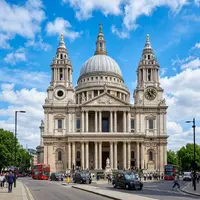
Christopher Wren almost certainly did not design the dome to produce the whispering effect. His primary concerns were structural integrity and visual proportion. The dome needed to be large enough to crown the cathedral grandly, strong enough to support the heavy stone lantern above, and beautiful from both inside and outside. The cathedral stands 111 metres tall, and Wren's triple-dome engineering was designed to achieve that imposing height.
The smooth, hard interior surface that creates the acoustic effect was a natural consequence of the construction materials and methods Wren used. The dome's inner shell is made of brick, rendered with a smooth plaster finish that happens to reflect sound very efficiently. A rougher surface, or one with more decorative relief, would absorb and scatter the sound waves rather than channelling them.
The acoustic effect was noticed early in the cathedral's history, and the gallery has been known by its current name for centuries. Whether Wren would have been pleased or bemused by this unintended feature of his design is a matter for speculation.
Visiting the Gallery
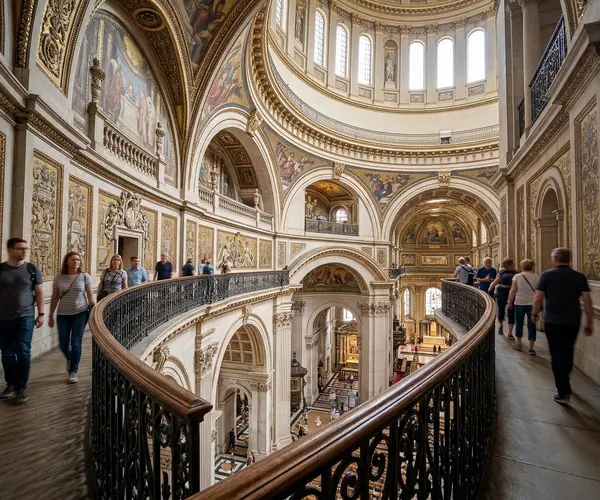
The Whispering Gallery is reached by climbing 259 steps from the cathedral floor. The staircase is wide and manageable, with handrails and occasional rest points. The gallery itself is a broad walkway that circles the interior of the dome, with a stone balustrade on the inner edge and the curved dome wall on the outer side.
From the gallery, you get an excellent elevated view of the cathedral's interior. The mosaic decorations in the dome, added by Sir William Blake Richmond between 1891 and 1904, are much more visible from this height. The nave below, with its black and white marble floor, stretches away to the west.
To test the whispering effect, you need a companion on the opposite side of the gallery. One person should face the wall and whisper while the other presses an ear against the wall on the far side. The effect works best when the gallery is quiet, which usually means visiting early in the morning or later in the afternoon. On busy days, the background noise from other visitors can make the whisper harder to distinguish.
The Whispering Gallery is also the first stop on the climb to the Stone Gallery and Golden Gallery above. Many visitors pause here to rest, test the acoustics, and take in the view before deciding whether to continue upward.