The Measurements
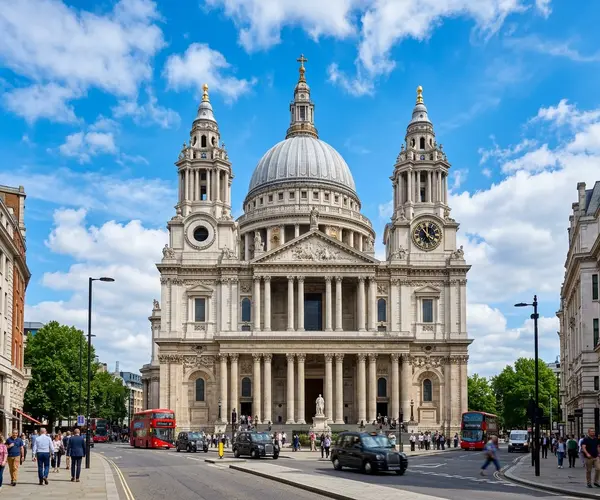
St Paul's Cathedral reaches 111 metres from ground level to the tip of the golden cross that sits on top of the lantern. The dome itself, one of the largest in the world, spans 65 metres at its widest point and rises to 68 metres above the cathedral floor at its interior peak.
These numbers place St Paul's among the tallest and most imposing cathedral domes anywhere. It is shorter than St Peter's Basilica in Rome (136 metres) but taller than the United States Capitol building (88 metres) and comparable in scale to the dome of Les Invalides in Paris.
How Wren Achieved the Height
Christopher Wren faced a significant engineering challenge. He wanted a dome that would be visually dramatic from both inside and outside the cathedral, but a dome that looks right from the outside, high and imposing against the skyline, does not necessarily create a pleasing interior space. A single dome tall enough to dominate London would have looked awkwardly elongated from below.
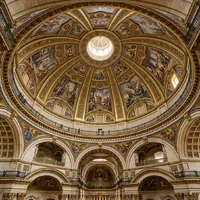
Wren's solution was to build three nested structures rather than one. The inner dome, the one visible from inside the cathedral, is relatively shallow, creating a harmonious proportioned ceiling when viewed from the nave. The outer dome, the one visible from outside, is taller and steeper, giving the building its commanding profile. Between the two sits a hidden brick cone that actually supports the weight of the stone lantern, ball, and cross above.
This triple-dome construction was an engineering innovation that solved both the aesthetic and structural problems simultaneously. The inner dome is decorative, the outer dome is architectural, and the cone between them is the load-bearing structure that makes the whole arrangement work.
London's Tallest Building for Three Centuries
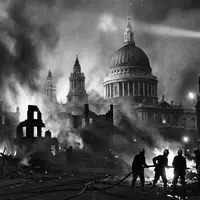
When St Paul's was completed in 1710, it immediately became the tallest structure in London, and it held that distinction for an extraordinary 300 years. The cathedral that rose to dominate the skyline was itself a replacement, built by Wren after the Great Fire of 1666 destroyed the medieval original. During those three centuries, London grew from a city of fewer than a million people to a global metropolis, yet nothing was built taller than Wren's cathedral.
This was not entirely by accident. From the 18th century onwards, there was an informal understanding, later formalised in planning guidelines, that buildings near the cathedral should not compete with its height. The view of St Paul's dome from various points across London was considered part of the city's character and worth protecting.
The first building to surpass St Paul's height was a matter of some debate, but the BT Tower (then called the Post Office Tower), completed in 1964 at 177 metres, was among the first to clearly exceed it. Today, the Shard at 310 metres is nearly three times the height of St Paul's.
Protected Views
Despite the modern skyline, the visibility of St Paul's is still actively protected by London's planning regulations. The London View Management Framework designates specific viewpoints, known as protected vistas, from which the dome of St Paul's must remain visible and unobstructed.
These protected views include sightlines from Parliament Hill on Hampstead Heath, from Richmond Park, from Greenwich Park, and from several points along the Thames. Any proposed building that would obstruct these views faces significant planning barriers. The result is that St Paul's dome remains a defining feature of the London skyline, visible from distances that would be impossible if unrestricted development had been allowed in every direction.
The Dome From Below and Above
The experience of the dome changes dramatically depending on your vantage point. From the cathedral floor, the inner dome appears to float above the nave, its surface decorated with monochrome paintings by Sir James Thornhill depicting scenes from the life of St Paul. The oculus at the top opens into the lantern above, drawing the eye upward.
From the Golden Gallery at the top of the dome, 85 metres above the floor, the perspective reverses. Looking down through the oculus into the cathedral below gives a sense of the scale that is impossible to appreciate from ground level. Looking outward, the panoramic view across London reveals why Wren's dome dominated the city for so long and why its protection continues to shape London's skyline today.