The Night of 29 December 1940
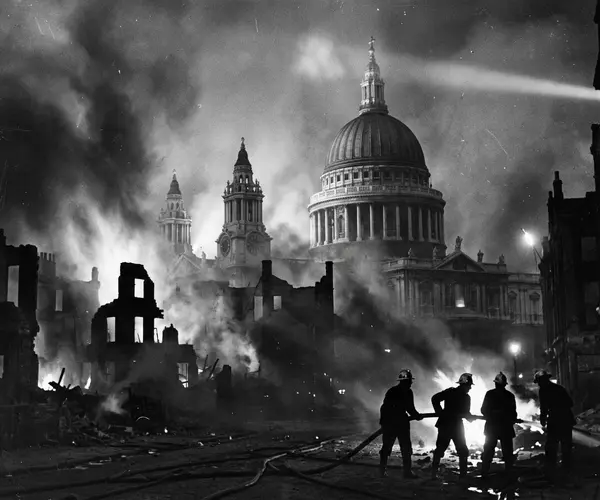
The most dangerous night for St Paul's Cathedral during the Second World War came on 29 December 1940, a night that became known as the Second Great Fire of London. The Luftwaffe dropped thousands of incendiary bombs on the City of London, and fires broke out across a vast area surrounding the cathedral.
The photograph taken that night by Herbert Mason from the roof of the Daily Mail building on Fleet Street shows the dome of St Paul's rising above billowing clouds of smoke, apparently untouched while everything around it burned. The image was published the following day and became an instant symbol of British resilience and defiance.
But St Paul's survival was not luck. It was the result of deliberate planning and considerable bravery.
The Fire Watchers
Winston Churchill had given a direct order that St Paul's must be saved at all costs. He understood the cathedral's symbolic importance to national morale. If St Paul's fell, it would be a devastating blow to the spirit of a city enduring nightly bombardment.
The cathedral's own fire watch team, the St Paul's Watch, was organised by the architect Godfrey Allen and consisted of volunteers from the cathedral staff, the Royal Institute of British Architects, and local businesses. They patrolled the roof, the galleries, and the interior throughout every air raid, armed with stirrup pumps, buckets of sand, and long-handled shovels.
On the night of 29 December, incendiary bombs landed on and around the cathedral repeatedly. The fire watchers extinguished each one before it could set the roof alight. One bomb lodged in the outer dome's lead sheeting and began to melt through. Had it burned through, the timber framework of the dome could have caught fire and the entire structure might have been lost. The bomb was dislodged and fell harmlessly to the Stone Gallery below, where it was dealt with.
The area surrounding the cathedral was not so fortunate. The buildings to the north, many of them dating from the medieval period, were destroyed in the firestorm. The cathedral stood in a landscape of devastation, intact but surrounded by rubble and ruin.
The Great Fire of 1666
The current St Paul's is not the first cathedral on this site. Old St Paul's, a vast medieval Gothic church with a spire that once reached 150 metres (taller than the current dome), had dominated London's skyline since the 13th century. It was already in poor condition by the time of the Great Fire, having lost its spire to a lightning strike in 1561 and suffered neglect during the English Civil War.
When the Great Fire broke out on 2 September 1666 in a bakery on Pudding Lane, it spread rapidly through the tightly packed wooden buildings of the City. The cathedral authorities believed Old St Paul's was safe because the surrounding buildings had been cleared, creating a firebreak. They were wrong.
The intense heat generated by the burning city created its own winds, carrying embers over the open space and onto the cathedral's roof. The lead roof melted and poured down the walls. The wooden scaffolding being used for Inigo Jones's restoration work caught fire. By the morning of 4 September, Old St Paul's was a ruin.
Wren's Cathedral Rises
Christopher Wren had been involved in plans to restore Old St Paul's before the fire, so he was the natural choice to design its replacement. His first design, a grand domed church in the shape of a Greek cross, was rejected by the clergy as too radical. His second, a massive domed structure known as the Great Model, was also turned down.
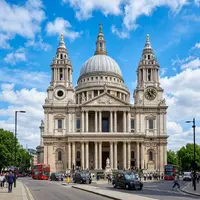
The design that was eventually approved, known as the Warrant Design, was more conventional, but Charles II gave Wren permission to make "ornamental" changes as construction progressed. Wren used this latitude liberally, and the cathedral that emerged over the next 35 years bore little resemblance to the approved drawings. The foundation stone was laid in 1675, and the cathedral was declared complete in 1710. Today, Wren himself lies buried in the crypt alongside Nelson, Wellington and over 200 other notable figures.
Two Fires, One Site
The parallel between the two fires is striking. In 1666, a medieval cathedral that had stood for centuries was lost because the defences were inadequate. In 1940, the replacement cathedral survived because people were organised, prepared, and willing to risk their lives on its roof during a bombing raid.
The dome that Herbert Mason photographed emerging from the smoke that December night was already 230 years old. It had survived because a small group of volunteers understood what it meant and refused to let it fall. That act of determined preservation is as much a part of St Paul's story as Wren's architecture or the centuries of worship that have taken place within its walls.