The Original Globe Theatre
The original Globe Theatre was built in 1599 by Shakespeare's playing company, the Lord Chamberlain's Men (later the King's Men). It stood in Southwark, on the south bank of the Thames, in an area that was already home to several other theatres and entertainment venues outside the jurisdiction of the City of London.
The theatre was constructed from the timbers of an earlier playhouse called simply The Theatre, which had stood in Shoreditch. When the lease on that land expired, the company dismantled the building and carried the oak frame across the river to rebuild it as the Globe.
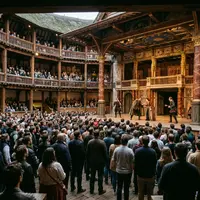
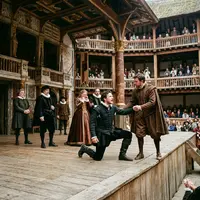
The original Globe hosted the premieres of many of Shakespeare's greatest plays, including Hamlet, Othello, King Lear and Macbeth. It could hold up to 3,000 spectators, with covered galleries for wealthier patrons and a standing yard for groundlings who paid a penny for entry.
On 29 June 1613, during a performance of Henry VIII, a theatrical cannon misfired and set the thatched roof alight. The entire building burned to the ground in under two hours. A second Globe was rebuilt on the same site within a year, but it was closed by the Puritans in 1642 and demolished in 1644.
The Reconstruction
The modern Globe exists because of the vision of American actor and director Sam Wanamaker, who first visited London in 1949 and was dismayed to find nothing marking the site of Shakespeare's most famous theatre beyond a small bronze plaque on a brewery wall.
Wanamaker spent decades campaigning and fundraising for a reconstruction. The project faced numerous obstacles, including planning disputes and financial difficulties, but construction finally began in 1987. Wanamaker died in 1993, four years before the theatre opened to the public.
Traditional Building Methods
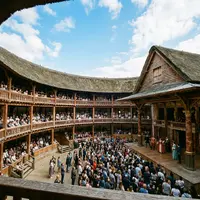
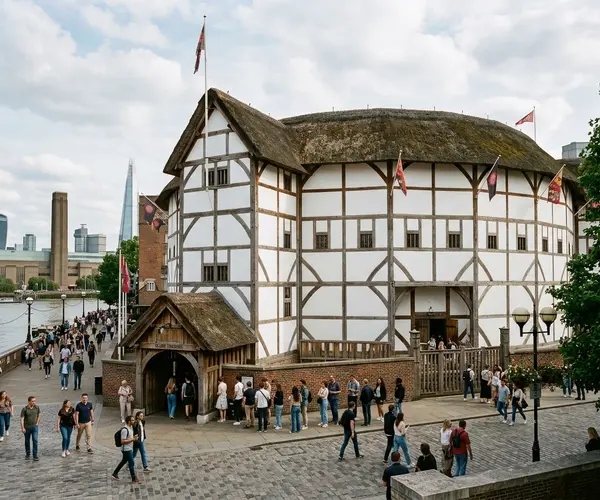
The reconstruction was built using methods and materials as close to the original as historical research allowed. The frame is constructed from green oak, joined with wooden pegs rather than metal bolts. The walls are finished with lime plaster, and the roof is thatched with Norfolk water reed.
The thatched roof was particularly significant. No thatched building had been permitted in central London since the Great Fire of 1666, and special permission had to be obtained. The thatch covers the galleries but leaves the yard and stage open to the sky, just as the original theatre was. Modern fire regulations required the installation of a sprinkler system and other safety measures within the thatch.
How Accurate Is It?
No detailed plans of the original Globe survive, so the reconstruction is based on archaeological evidence, contemporary illustrations, written descriptions and scholarly interpretation. The dimensions, the number of gallery levels, the shape of the stage and the open-air design are all informed by the best available evidence, but they involve a degree of educated guesswork.
Archaeological excavations of the original Globe's foundations in 1989 provided crucial measurements, confirming that the building was a polygon of roughly 30 metres in diameter. However, the excavated area was limited because the original foundations lie partly beneath a listed building, so only a section could be uncovered.
Where Is the Original Site?
The original Globe stood at what is now the junction of Park Street and Porter Street in Southwark, approximately 230 metres from the reconstruction. A commemorative plaque marks the approximate location. Part of the original foundations can be seen through a viewing window at ground level, though access is limited.