The Foundation in 597 AD
Canterbury Cathedral traces its origins to 597 AD, when St Augustine arrived in Kent on a mission from Pope Gregory the Great to convert the Anglo-Saxons to Christianity. King Ethelbert of Kent, whose wife Bertha was already a Christian, allowed Augustine to establish a church in Canterbury. This church became the seat of the Archbishop of Canterbury, a role that has continued unbroken to the present day.
Nothing visible remains of Augustine's original church. Archaeological evidence suggests it was a relatively modest structure, built on or near the site of a Roman building. Over the following centuries, the church was rebuilt and enlarged several times by successive archbishops, but records of these early buildings are fragmentary.
The Norman Rebuilding
The cathedral that visitors see today began to take shape after the Norman Conquest of 1066. Archbishop Lanfranc, appointed by William the Conqueror, demolished the damaged Saxon cathedral and built a new one in the Norman Romanesque style, beginning around 1070. This was a much larger and more ambitious building than anything that had stood on the site before.
Lanfranc's cathedral was further extended and embellished by his successor, Archbishop Anselm, who enlarged the eastern end of the building in the early 12th century. The crypt from this period survives and is one of the largest and finest Norman crypts in England, with carved columns and capitals that are among the earliest examples of Romanesque sculpture in the country.
The Gothic Transformation
A devastating fire in 1174, just four years after the murder of Thomas Becket, destroyed much of the eastern end of the cathedral. The rebuilding that followed was carried out in the new Gothic style by a French architect, William of Sens, and later by an English architect known as William the Englishman. This Gothic choir and Trinity Chapel, built to house the shrine of Thomas Becket, represented a dramatic change from the heavy Romanesque arches of the Norman building.
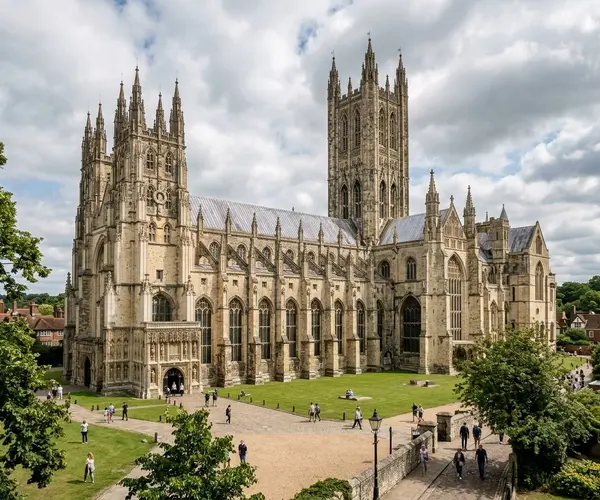
The nave was rebuilt in the Perpendicular Gothic style in the late 14th century under Archbishop Sudbury and his successors. The great central tower, known as Bell Harry Tower, was added between 1490 and 1510 and remains the most prominent feature of the cathedral's exterior.
Continuous Use for Over 1,400 Years
What makes Canterbury Cathedral remarkable is not just its age but its continuity. It has served as the mother church of the worldwide Anglican Communion and the seat of the Archbishop of Canterbury without interruption since 597 AD. While the physical building has been rebuilt, extended and modified many times, the institution it represents has endured through the fall of Rome's influence, the Norman Conquest, the Black Death, the Reformation and two World Wars.
The cathedral was designated a UNESCO World Heritage Site in 1988, together with the ruins of St Augustine's Abbey and St Martin's Church nearby. St Martin's Church, which predates the cathedral and may date from the Roman period, is often cited as the oldest parish church in England still in use.
Layers of History
Walking through Canterbury Cathedral today means passing through nearly a thousand years of architecture. The Norman crypt, the Gothic choir, the Perpendicular nave and the Tudor Bell Harry Tower each represent a different era and a different approach to building. This layering of styles is part of what makes the cathedral such a rich and rewarding place to visit.