One of London's Great Green Spaces
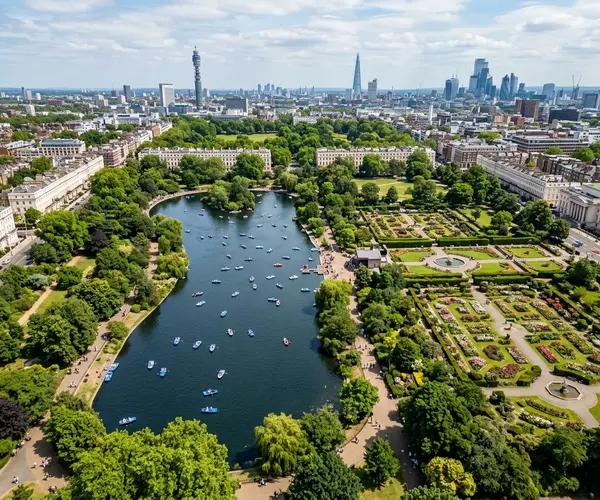
Regent's Park covers 395 acres of north-central London, making it one of the capital's most significant green spaces. To put that in perspective, it is roughly twice the size of the City of London financial district. The park stretches from Marylebone Road in the south to the boundary with Primrose Hill in the north, and from Albany Street in the east to the grand Nash terraces along the Outer Circle in the west.
The park was designed by the architect John Nash in 1811 as part of an ambitious plan for the Prince Regent (later George IV) that would have connected the park to Carlton House near St James's via a grand processional route. The full scheme was never completed, but the park itself was laid out to Nash's plans and remains one of his finest achievements. The elegant white stucco terraces that ring the park were also designed by Nash and give Regent's Park its distinctive architectural setting.
What Fills 395 Acres
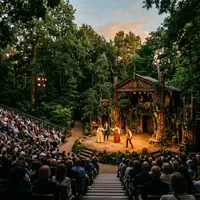
The sheer size of the park allows it to accommodate an extraordinary range of uses without any single one dominating. London Zoo occupies a large section in the northern part of the park. The Open Air Theatre sits in a wooded area near Queen Mary's Gardens. The boating lake offers rowing boats for hire during the warmer months. Sports pitches for football, cricket, rugby and softball fill the central areas, and tennis courts and running tracks provide further facilities.
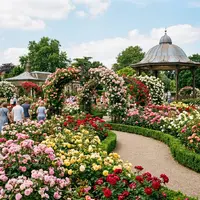
Queen Mary's Gardens, the formal garden at the heart of the park, contains London's finest rose collection with over 12,000 roses. The Avenue Gardens near the southern entrance offer formal bedding displays, while wilder areas of the park provide habitat for hedgehogs, herons and a large population of waterfowl.
The Inner and Outer Circles
The park's layout is based on two concentric circular roads. The Outer Circle runs around the perimeter of the park, a distance of about 2.7 miles, and is popular with runners and cyclists. The Inner Circle encloses the central area that contains Queen Mary's Gardens and the Open Air Theatre, creating a quieter and more intimate space within the larger park.
Between the two circles lie the main open spaces, sports grounds and the boating lake. This ring-shaped layout means that the park always has both busy and quiet areas. The southern and eastern sections near Baker Street and Regent's Park tube stations tend to be busiest, while the northern reaches towards the zoo and the canal are often surprisingly peaceful.
Exploring on Foot
Walking across the full width or length of Regent's Park takes about 25 to 30 minutes at a steady pace. However, the park rewards a slower approach. Following the canal along the northern boundary leads to both London Zoo and Camden Lock. Circling the boating lake takes about 15 minutes and passes through some of the park's most attractive scenery. Walking the full Outer Circle is a popular running route but also makes for a pleasant hour-long stroll.
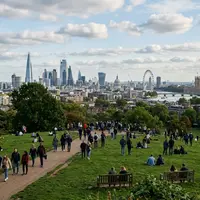
The park connects to Primrose Hill to the north, adding another 78 acres of parkland and one of London's best viewpoints. Though Primrose Hill is technically a separate park, the two adjoin and can easily be combined into a single walk. Together, they offer over 470 acres of continuous green space in one of the most densely populated parts of the city.