A Tradition of Public Speaking
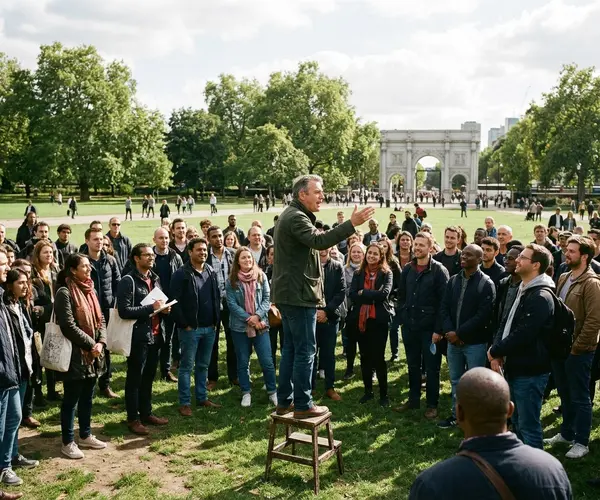
Hyde Park's Speakers' Corner occupies the northeast corner of the park, close to Marble Arch, and has been associated with public speaking and debate for well over a century. The idea is simple. Anyone can turn up, stand on a platform (or a stepladder, or an upturned crate), and address whoever is willing to listen.
The tradition was formalised by the Royal Parks and Gardens Regulation Act of 1872, which designated the area as a place where public meetings could be held. Before that, the area had already become an informal gathering point for political agitation and protest, partly because of its proximity to the Tyburn gallows, where condemned prisoners were traditionally allowed a final speech before execution.
How It Works
There is no booking system, no application process, and no formal stage. Speakers simply arrive, usually on Sunday mornings when the crowds are largest, and begin talking. Topics range from politics and religion to philosophy, conspiracy theories, and personal grievances. Heckling is expected and often encouraged, and the exchanges between speakers and their audiences are part of the appeal.
The only legal restrictions are those that apply to any public speech in England. Speakers must not incite violence, breach the peace, or use threatening or abusive language. In practice, the boundaries are generously interpreted, and Speakers' Corner has long been a place where unconventional, provocative, and unpopular views are aired openly.
Famous Speakers
The site has attracted some notable voices over the decades. Karl Marx is believed to have spoken here during his years of exile in London in the 1850s and 1860s. Vladimir Lenin, who lived in London in 1902 and 1903, reportedly visited the corner. George Orwell, whose writings on free speech and political language remain widely read, also spoke here.
The suffragettes used Speakers' Corner as a rallying point during their campaign for women's voting rights in the early 1900s. Marcus Garvey, the Jamaican political activist, spoke here during his time in London. In more recent decades, figures from across the political spectrum have used the platform, though most speakers on any given Sunday are ordinary people with something to say.
The Culture of Debate
What makes Speakers' Corner distinctive is not the speeches themselves but the culture of engagement that surrounds them. Audiences do not simply listen. They interrupt, question, challenge, and argue. A speaker making a political argument will face immediate pushback from anyone who disagrees. A religious speaker will be questioned on theology by someone who holds a different view.
This back-and-forth is the living tradition of the place. It can be robust, sometimes heated, occasionally funny, and always unpredictable. On a busy Sunday, half a dozen speakers might be holding forth simultaneously, each surrounded by their own crowd, the conversations overlapping and competing for attention.
Visiting Speakers' Corner Today
Sunday mornings remain the best time to visit, roughly from mid-morning onwards. During the week, the area is usually quiet. The corner itself is unremarkable as a physical space. There is no stage, no microphone system, and no formal markers. It is just a patch of park near a busy road, which makes the tradition all the more remarkable.
Speakers' Corner continues to function as a living demonstration of free speech, imperfect, messy, and sometimes uncomfortable, but enduring. It has inspired similar spaces in cities around the world, from Singapore to Trinidad, though none carry quite the same historical weight.
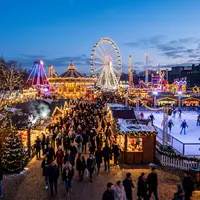
The nearest Underground station is Marble Arch, which puts you within a minute's walk of the corner. During the Christmas season, the eastern side of the park transforms into Winter Wonderland, drawing millions of visitors with ice skating, markets and fairground rides.