Understanding the Size
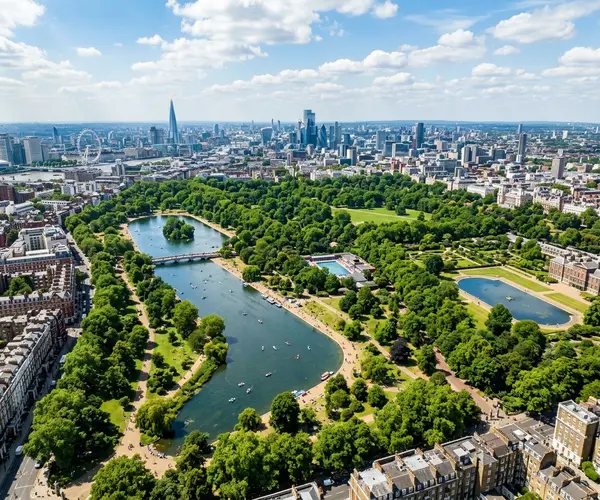
Hyde Park stretches across 350 acres of central London, bounded by Park Lane to the east, Knightsbridge to the south, and Bayswater Road to the north. To put that in perspective, it is roughly the same size as 265 football pitches.
The park merges seamlessly with Kensington Gardens to the west, and most visitors do not realise they have crossed from one into the other. The dividing line runs roughly along the West Carriage Drive and the Serpentine Bridge. Together, the two parks cover 625 acres, an area larger than the entire principality of Monaco.
How Hyde Park Compares
Among London's Royal Parks, Hyde Park is the fourth largest. Richmond Park is by far the biggest at 2,500 acres, followed by Bushy Park at 1,100 acres and Regent's Park at 395 acres. However, none of those parks sit as centrally as Hyde Park, which occupies some of the most valuable real estate in the world.
Compared to famous parks internationally, Hyde Park is about 40 percent of the size of New York's Central Park (843 acres) but slightly larger than the Bois de Boulogne's central section in Paris. The combined Hyde Park and Kensington Gardens space, though, is comparable to Central Park in total area.
A History of Changing Boundaries
The park's current size is considerably smaller than its original extent. When Henry VIII seized the land from Westminster Abbey in 1536, he acquired roughly 600 acres of what had been the Manor of Eia. He used the entire area as a private hunting ground for deer and wild boar.
Charles I opened the park to the public in 1637, and it quickly became a fashionable meeting place for London society. Charles II created the Ring, a circular carriage drive where the wealthy would parade in their coaches.
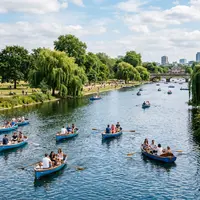
Kensington Gardens was originally part of Hyde Park but was separated in the early 18th century when William III purchased Nottingham House (now Kensington Palace) and had formal gardens laid out around it. Queen Caroline, wife of George II, commissioned the creation of the Serpentine in 1730, which now forms a natural boundary between the two parks.
Walking Across the Park
Walking from one side of Hyde Park to the other takes roughly 20 to 25 minutes at a steady pace. From Hyde Park Corner in the southeast to the Italian Gardens at the northwestern edge of Kensington Gardens is a walk of about 45 minutes to an hour, depending on how often you stop.
The park's path network covers over 12 miles, offering routes for walking, running, and cycling. The broadwalk along the Serpentine is one of the most popular routes, while Rotten Row, the sandy bridleway that runs east to west, stretches for about a mile and a half.
Making the Most of the Space
The sheer size of Hyde Park means that even on busy days, it is possible to find quiet areas. The northeastern section near the Meadow is often less crowded than the Serpentine shoreline or Speakers' Corner. The area around the Dell, a small sunken garden near Hyde Park Corner, is another peaceful spot that many visitors walk past without noticing.
For first-time visitors, the best approach is to enter at one end and walk through to the other, taking in the Serpentine, the Diana Memorial Fountain, and whatever else lies along your route. Trying to see everything in a single visit is unnecessary and the park rewards a slower pace.