From Power Station to Art Space
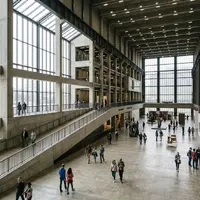
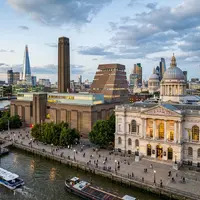
The Turbine Hall is the centrepiece of the Tate Modern and the first space most visitors encounter when entering through the main west entrance. It occupies the full length of the former Bankside Power Station, which generated electricity for London from 1947 to 1981. When architects Herzog and de Meuron converted the building into a gallery in 2000, they made the inspired decision to leave the Turbine Hall largely untouched, preserving its industrial scale and character.
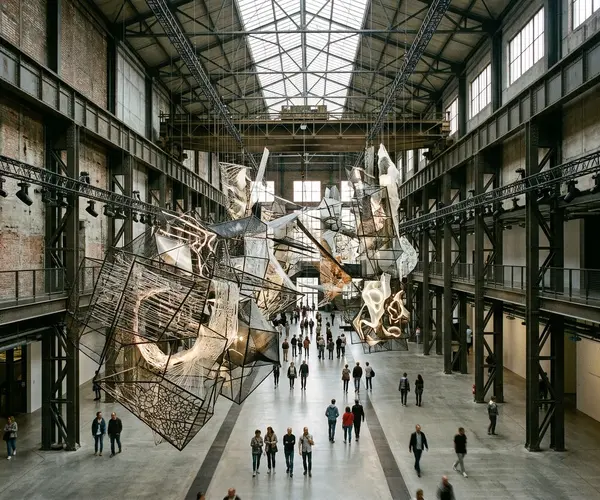
The result is a space of extraordinary proportions. At 152 metres long, 23 metres wide and 35 metres high, the hall dwarfs almost everything placed inside it. A long ramp descends from the west entrance to the floor level, giving visitors a dramatic first view of whatever installation currently fills the space.
The Commissions
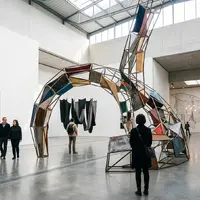
Since the museum opened, the Turbine Hall has hosted a series of ambitious commissioned artworks. These are specifically created for the space and often push the boundaries of what gallery art can be.
Some of the most memorable commissions include Olafur Eliasson's The Weather Project in 2003, which filled the hall with an artificial sun and mist, creating the illusion of a sunset that drew over two million visitors. Ai Weiwei covered the floor with 100 million hand-painted porcelain sunflower seeds in 2010. Carsten Höller installed a series of giant slides in 2006, turning the gallery into a playground.
The Hyundai Commission, launched in 2015, continues this tradition with annual large-scale installations. Each commission is a new response to the unique challenges and possibilities of the space.
Why It Works
The Turbine Hall works as an art space because of its scale. Artists are given a canvas that no conventional gallery can offer. The height allows for towering sculptures and suspended structures. The length permits works that unfold as you walk through them. The industrial architecture provides a neutral, powerful backdrop that does not compete with the art.
The space also works socially. It functions as a public square within the museum, a place where visitors gather, sit, meet friends and simply absorb the atmosphere. Children run across the floor. People lie on their backs looking up. It has a communal energy that is rare in art galleries.
Visiting the Turbine Hall
The Turbine Hall is always free and does not require a ticket or advance booking. It is open during normal museum hours. The installation changes periodically, so it is worth checking what is currently on show before you visit. Even when the hall is between commissions, the space itself is worth experiencing for its architectural drama alone.
The hall connects to the main gallery levels via escalators and lifts on both sides, making it a natural starting point for exploring the rest of the museum's best exhibits.