The Coat Nelson Died In
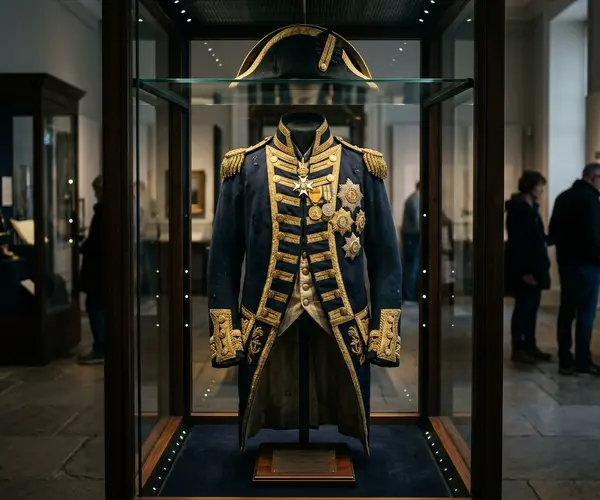
The National Maritime Museum in Greenwich holds one of the most historically significant garments in Britain. The vice-admiral's undress coat that Horatio Nelson wore on 21 October 1805, the day of the Battle of Trafalgar, is on permanent display in the Nelson gallery. The coat is a dark blue wool garment with the insignia of his rank and the embroidered stars of his orders of chivalry sewn onto the left breast.
What makes the coat so arresting is the damage visible on the left shoulder. A ragged hole marks the point where a musket ball entered Nelson's body, fired by a French marksman positioned in the rigging of the enemy ship Redoutable. The ball passed through the epaulette and into Nelson's shoulder, smashing through his chest and lodging in his spine. He was carried below decks to the surgeon's cockpit, where he died approximately three hours later.
The Musket Ball That Killed Him
In a remarkably sobering display, the museum also holds the actual musket ball that ended Nelson's life. The lead ball was extracted from his body by the ship's surgeon, William Beatty, who preserved it along with a section of Nelson's coat and a piece of the gold lace from his epaulette. Beatty later wrote a detailed account of Nelson's wounds and death, which remains an important historical document.
Seeing the uniform and the ball together creates a powerful connection to the events of that day. These are not replicas or reproductions. They are the actual objects from one of the most consequential naval battles in history, and they retain the ability to stop visitors in their tracks.
Other Nelson Artefacts
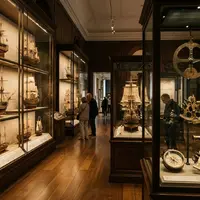
The Nelson galleries extend well beyond the Trafalgar uniform. The museum holds personal letters written by Nelson, including correspondence with Lady Emma Hamilton. His medals, decorations and presentation swords are displayed alongside his personal effects, building a picture of the man behind the legend.
There are also items connected to other significant moments in Nelson's career. He lost his right arm at the Battle of Santa Cruz de Tenerife in 1797, and objects related to this and other engagements are part of the collection. Together, these artefacts trace the career of Britain's most famous naval commander from his early service to his death at the moment of his greatest victory.
The Battle of Trafalgar in Context
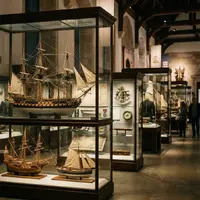
The museum places Nelson's story within the broader context of the Napoleonic Wars and British naval supremacy. Display panels and interpretive materials explain why Trafalgar mattered, how it secured British control of the seas for a century and how Nelson's death transformed him from a brilliant but controversial admiral into a national hero of almost mythical status.
The Nelson Column in Trafalgar Square, the pubs and streets named after him across the country, and the enduring fascination with his life and death all trace back to the events that these objects witnessed. Visiting the Maritime Museum gives you the chance to see the physical evidence of that history, preserved and displayed with appropriate care and respect.
Visiting the Nelson Gallery
The Nelson galleries are part of the museum's free permanent collection, so there is no charge to see the uniform and associated artefacts. The galleries are located on the ground floor and are well signposted from the main entrance. Allow at least 30 minutes to explore the Nelson displays thoroughly, and consider combining your visit with the rest of the museum's excellent free galleries, including the best exhibits at the National Maritime Museum.