Before the Piazza
The name Covent Garden gives a clue to the area's earliest known use. Before it became a piazza, market or entertainment district, the land belonged to Westminster Abbey and was used as a kitchen garden, or "convent garden," to supply the monks. This monastic connection dates back to at least the 13th century, when the area was open fields and orchards on the outskirts of medieval London.
After the dissolution of the monasteries under Henry VIII in the 1530s, the land was granted to the Russell family, who would later become the Earls and Dukes of Bedford. The Russells initially used the land for their own estates, but by the early 17th century they saw an opportunity to develop it into something more profitable.
Inigo Jones and the 1631 Piazza
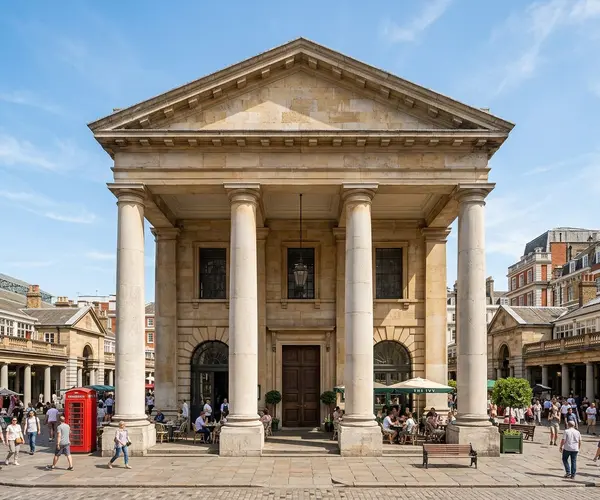
In 1631, the 4th Earl of Bedford commissioned the architect Inigo Jones to design a residential square on the site. Jones created what became England's first planned public square, modelled on the piazzas he had seen in Italy, particularly the Piazza d'Arme in Livorno. The design featured elegant terraced houses on the north and east sides, with St Paul's Church (known as the Actors' Church) on the west side.
The piazza Jones created at Covent Garden was revolutionary for London. At a time when most of the city's streets were narrow, crooked medieval lanes, Jones introduced a grand, open space with classical proportions and Italianate architecture. It immediately became a fashionable address and a model for future London squares like Bloomsbury Square and St James's Square.
The Market Arrives
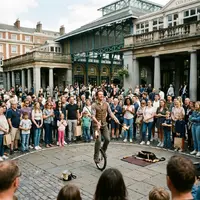
Informal trading began in the piazza during the 1650s, with a few market stalls selling fruit and vegetables appearing in the open square. The question of whether Covent Garden is still a market today is one that traces its answer back to these origins. The market grew steadily, and by the late 17th century it had become London's principal wholesale produce market. The elegant residential square that Inigo Jones had designed was increasingly overtaken by commercial activity.
The 5th Duke of Bedford obtained a royal charter for the market in 1670, formalising what had already become established practice. As the market grew larger and more chaotic throughout the 18th century, the original residential character of the piazza was lost. The fashionable families who had once lived in Jones's terraces moved away to newer, quieter addresses.
Charles Fowler's Market Hall
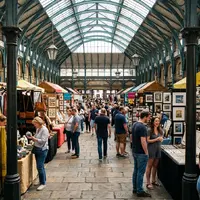
By the early 19th century, the open-air market had become impossibly congested. In 1830, the 6th Duke of Bedford commissioned architect Charles Fowler to design a permanent covered market building. Fowler created the neoclassical iron and glass hall that still stands today, bringing order to centuries of informal trading.
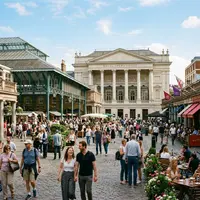
The building was both functional and handsome. Its iron columns, glass roof and classical stone facade gave the market a dignity that matched its importance to London's food supply. Additional structures were added over the following decades, including the Floral Hall in 1860 (now incorporated into the Royal Opera House) and the Jubilee Market in 1904.
The Modern Era
The wholesale market operated from Fowler's hall for nearly 150 years before relocating to Nine Elms in 1974. The buildings were saved from demolition by a determined preservation campaign and reopened in 1980 as the shopping and cultural destination that exists today.
The architecture visitors see now is essentially a layering of nearly four centuries of development. The piazza layout dates from 1631. St Paul's Church was built between 1631 and 1633. The market hall is from 1830. And the surrounding streets retain elements from every period in between. Walking through Covent Garden is walking through 400 years of London history compressed into a few compact blocks.