Kenwood House
A grand neoclassical villa on Hampstead Heath — free entry to Rembrandt, Vermeer and one of Robert Adam's finest interiors
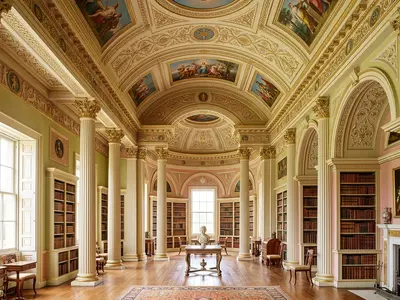
A grand neoclassical villa on Hampstead Heath — free entry to Rembrandt, Vermeer and one of Robert Adam's finest interiors
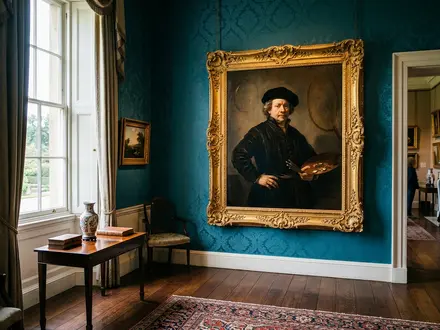
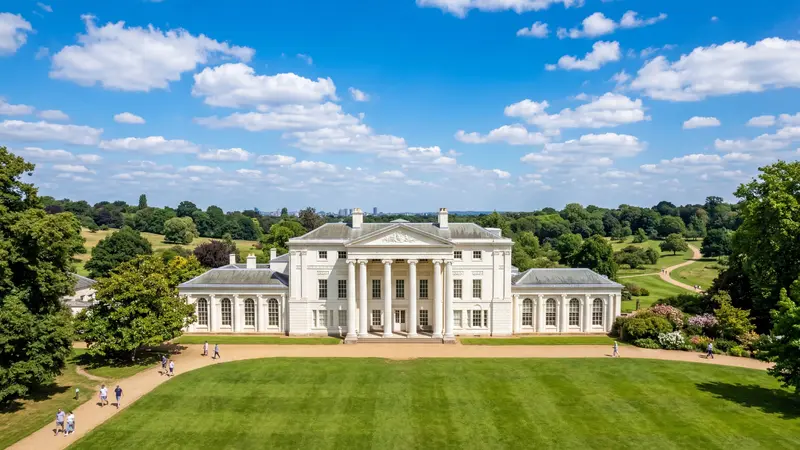
Kenwood House sits on the northern edge of Hampstead Heath, a neoclassical villa housing one of London's most remarkable free art collections. The Iveagh Bequest, given to the nation in 1928 by Edward Cecil Guinness, 1st Earl of Iveagh, includes Rembrandt's Self-Portrait with Two Circles and Vermeer's The Guitar Player — works that alone would justify a dedicated gallery.
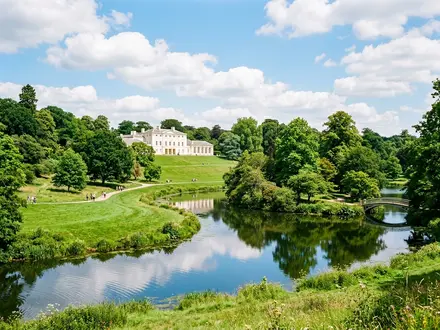
Beyond the paintings, visitors find Robert Adam's celebrated library, 112 acres of landscaped parkland designed by Humphry Repton, and views across London that stretch as far as St Paul's Cathedral on a clear day.
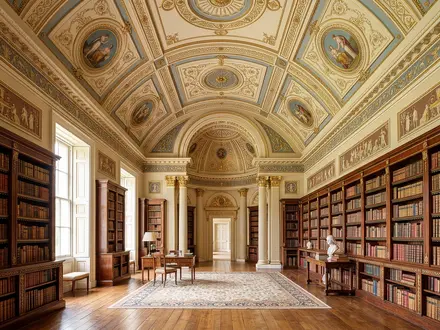
A house has stood on this site since at least the early seventeenth century, but Kenwood's story truly begins in 1764 when William Murray, 1st Earl of Mansfield and Lord Chief Justice of England, commissioned the Scottish architect Robert Adam to transform the property into a grand villa. Adam added the celebrated library, known as the Great Room, and remodelled the south front with its distinctive portico and stucco facade. The work, completed by 1779, ranks among Adam's most accomplished domestic commissions.
Lord Mansfield is remembered not just as a patron of architecture but as a pivotal legal figure. His 1772 ruling in the Somerset case was widely interpreted as ending slavery in England. Kenwood itself was home to Dido Elizabeth Belle, Mansfield's mixed-race great-niece, who lived here from around 1766 and was raised alongside her cousin Elizabeth Murray. The 2013 film Belle brought Dido's remarkable story to a wider audience.
After the Mansfield family sold the estate in 1922, brewing magnate Edward Cecil Guinness, 1st Earl of Iveagh, purchased it and filled the rooms with his outstanding art collection. On his death in 1927, he bequeathed both house and paintings to the nation.
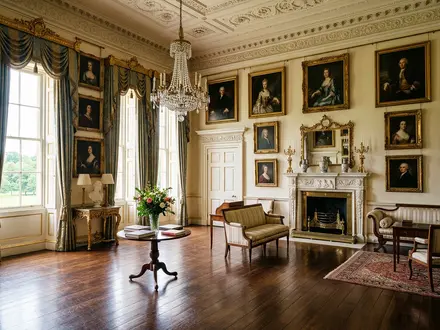
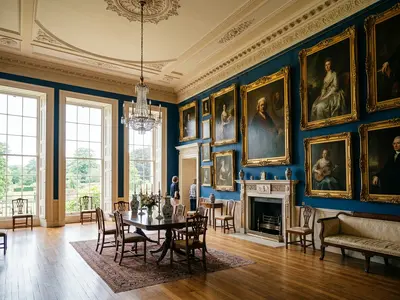
The Iveagh Bequest is the centrepiece of any visit. The collection of sixty-three paintings hangs in intimate period rooms exactly as the Earl intended — not a conventional gallery but the atmosphere of a great eighteenth-century house. Rembrandt's Self-Portrait with Two Circles, one of the artist's final and most powerful works, dominates the dining room. Vermeer's The Guitar Player, one of just thirty-seven known works by the Dutch master, hangs nearby alongside canvases by Gainsborough, Reynolds, Turner and Van Dyck.
The Adam Library is worth the visit alone. The double-height room, with its apsidal ends screened by Corinthian columns and a richly painted coved ceiling, was inspired by ancient Roman bath houses and remains one of the finest neoclassical interiors in England. The Bloomberg Connects app provides a free digital guide with audio commentary from the house curators.
Beyond the house, the 112 acres of parkland designed by Humphry Repton offer meadows, ancient woodland, a picturesque lake and views across London that reach St Paul's Cathedral on a clear day. The grounds connect directly to Hampstead Heath, making Kenwood an ideal start or end point for a longer walk.
Hampstead Heath itself is London's greatest wild park, with bathing ponds, Parliament Hill viewpoint and miles of walking trails all within easy reach. The charming streets of Hampstead village lie a twenty-minute walk south, with independent bookshops, pubs and Keats House — the Regency villa where John Keats wrote Ode to a Nightingale.
Heading north along Hampstead Lane brings you to Highgate village and Highgate Cemetery, the atmospheric Victorian burial ground where Karl Marx is interred. The Spaniards Inn, a sixteenth-century pub on Spaniards Road between Kenwood and Hampstead, is a popular stopping point for walkers and was once frequented by Dickens, Keats and Byron.
Entry to Kenwood House, grounds and the Iveagh Bequest art collection is completely free. No booking is required, though advance online tickets are recommended to guarantee entry.
The free Bloomberg Connects app includes room-by-room audio guides narrated by Kenwood's curators. Download it before your visit as mobile signal can be patchy.
The house opens at 10am and is quietest in the first hour. By lunchtime the cafe and main rooms fill up, especially at weekends and during school holidays.
Walk from Hampstead station across the Heath to Kenwood for the best approach. The uphill route takes around 30 minutes and the views improve as you climb.
The volunteer-run bookshop in the grounds sells donated books at bargain prices. Stock changes regularly and proceeds support the Friends of Kenwood.
This sixteenth-century pub sits on Spaniards Road between Kenwood and Hampstead station. It serves good food and real ales and has a large beer garden.

London Travel Writer · 12+ years covering UK attractions and tourism
Last reviewed: June 2, 2026