Greenwich Foot Tunnel
A 370-metre pedestrian tunnel beneath the Thames — linking Greenwich to the Isle of Dogs since 1902
A 370-metre pedestrian tunnel beneath the Thames — linking Greenwich to the Isle of Dogs since 1902
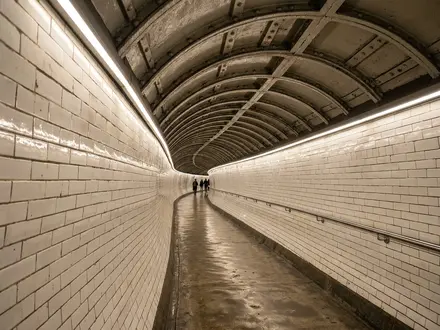
The Greenwich Foot Tunnel opened on 4 August 1902, giving south London workers a free route beneath the Thames to the docks and shipyards of the Isle of Dogs. Designed by Sir Alexander Binnie and lined with 200,000 glazed white tiles, the tunnel runs 370 metres at a depth of 15 metres below the river — and it has been open to pedestrians around the clock ever since.
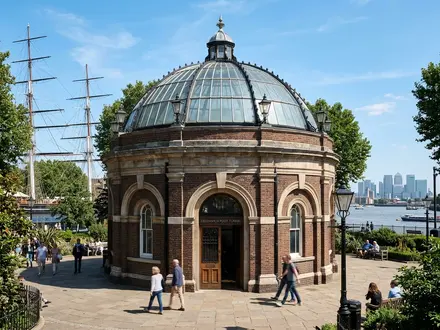
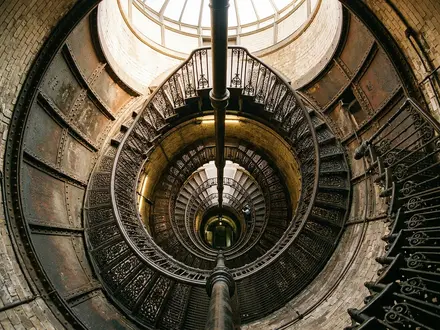
Visitors descend via a spiral staircase or lift beneath a distinctive glazed dome on the Greenwich waterfront, walk the gently curving tunnel beneath the riverbed, and emerge at Island Gardens with one of London's finest views back across the water to the Old Royal Naval College and the Queen's House.
The Greenwich Foot Tunnel was commissioned by London County Council to provide a free pedestrian crossing beneath the Thames, replacing a ferry service that was expensive, weather-dependent and frequently overcrowded. Civil engineer Sir Alexander Binnie designed the tunnel, and construction began in June 1899 under contractor John Cochrane & Co. Workers used a Greathead shield to bore through the London clay, lining the passage with cast-iron rings bolted together and coated in concrete.
The tunnel opened on 4 August 1902 at a total cost of around 127,000 pounds. It was an immediate success, giving thousands of workers living in south-east London direct access to the docks, shipyards and factories on the Isle of Dogs. Lifts were added in 1904, and the tunnel has remained in continuous use ever since — surviving bomb damage during the Second World War, when sections of the original tile lining were replaced with reinforced steel and concrete panels.
The tunnel was Grade II listed in 2012, recognising its significance as one of only a handful of pedestrian tunnels beneath the Thames and a rare surviving example of Edwardian subterranean engineering.
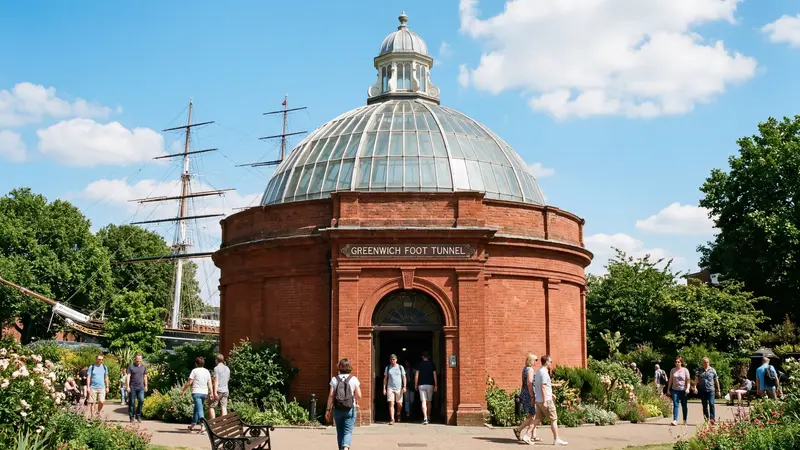
The experience begins at the southern entrance in Cutty Sark Gardens, where a circular brick building topped with a glazed dome marks the shaft entrance. Inside, a helical staircase of 100 steps spirals down to the tunnel floor 15 metres below. Lifts are also available, though they are occasionally out of service for maintenance.
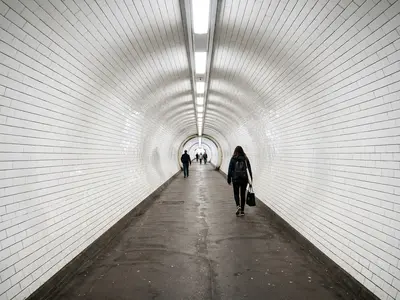
The tunnel itself stretches 370 metres in a gentle curve, lined with 200,000 white glazed tiles that reflect the overhead strip lighting and amplify every footstep. The internal diameter is just 2.7 metres, creating an unexpectedly intimate space beneath one of the world's busiest waterways. At the midway point, a subtle change in the floor tiles marks the boundary between the Royal Borough of Greenwich and the London Borough of Tower Hamlets.
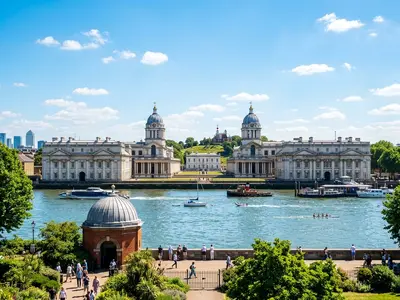
Emerging from the northern exit, visitors step into Island Gardens — a small waterfront park with what Canaletto is said to have called the finest view in the world, looking south across the Thames to the symmetrical baroque facades of the Old Royal Naval College.
The southern entrance places visitors within moments of several major Greenwich landmarks. The Cutty Sark — the world's last surviving tea clipper — sits directly beside the tunnel entrance. The National Maritime Museum and the Queen's House are a five-minute walk through Greenwich Park, and the Royal Observatory, home of the Prime Meridian line, crowns the hill above.
On the northern side, Island Gardens offers a peaceful spot to photograph the Greenwich waterfront. The Museum of London Docklands at West India Quay is a fifteen-minute walk north, and Canary Wharf's shops and restaurants are equally accessible. The tunnel works well as a connecting route between Greenwich's historic attractions and the modern developments of the Isle of Dogs.
The tunnel is completely free to use at all times. No tickets or booking required.
The lifts at both ends are occasionally out of service for maintenance. Check the Royal Borough of Greenwich website before visiting if you need step-free access.
The tunnel is busiest during weekday rush hours when commuters use it as a Thames crossing. Early mornings, evenings and weekends are much quieter for a leisurely walk.
Start at the Greenwich end and walk north. Emerging at Island Gardens rewards you with a spectacular panorama of the Old Royal Naval College across the water.
Pair the tunnel walk with the Cutty Sark, National Maritime Museum and the Royal Observatory. All are within ten minutes of the southern tunnel entrance in Greenwich.
Local bylaws require cyclists to walk their bikes through the tunnel. The narrow diameter makes cycling impractical and enforcement cameras monitor the passage.

London Travel Writer · 12+ years covering UK attractions and tourism
Last reviewed: March 9, 2026