A Venue Like No Other
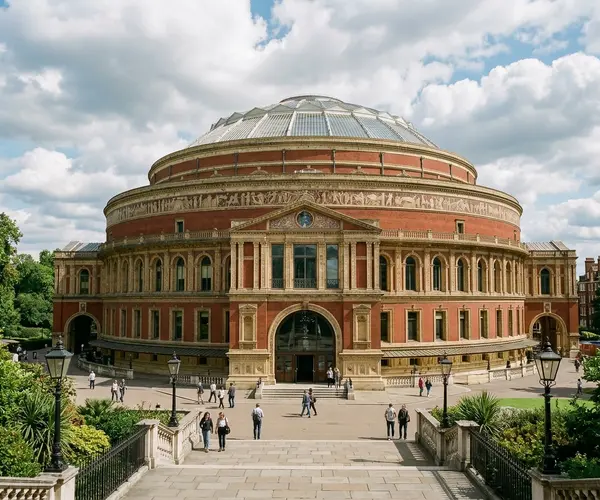
The Royal Albert Hall is immediately recognisable. Its circular red-brick and terracotta form rises from the edge of Kensington Gore, directly across the road from the Albert Memorial in Hyde Park. The building looks like a Roman amphitheatre reimagined for Victorian London, and that is essentially what it is. Designed by Captain Francis Fowke and Major-General Henry Y.D. Scott, it was inspired by ancient amphitheatres but built with the engineering ambition of the industrial age.
The hall was conceived as part of Prince Albert's vision for a cultural quarter in South Kensington. Albert died in 1861, ten years before the building was completed, but Queen Victoria laid the foundation stone in 1867 and named it in his memory. When it opened on 29 March 1871, Victoria was reportedly too emotional to speak, and the opening words were delivered by Edward, Prince of Wales.
What Happens There
The range of events at the Royal Albert Hall is extraordinary. In a single season you might find the BBC Proms, a rock concert, a film screening with live orchestra, a tennis match, a graduation ceremony, and a charity gala. The hall hosts over 390 events every year, making it one of the busiest performance venues in the world.
Classical music has always been central to its identity, with the BBC Proms running every summer since 1941. But the hall has also welcomed the biggest names in popular music. The Beatles, Led Zeppelin, Eric Clapton, Adele, and countless others have all performed on its stage. Clapton has played there over 200 times.
The Building Itself
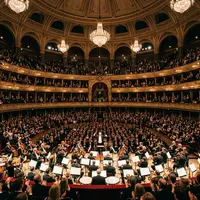
The auditorium is arranged in a series of tiers rising from the arena floor to the gallery. The design gives the space an intimacy that belies its size. Even from the upper levels, you feel connected to the performance in a way that is unusual for a venue of this capacity.
The domed ceiling, made of wrought iron and glass, was an engineering marvel of its time. For decades, the hall suffered from a notorious echo problem. Sound would bounce off the dome and arrive at listeners a fraction of a second after the original, creating a blurred effect. This was eventually addressed with a series of acoustic diffusers, the mushroom-shaped fibreglass discs that hang from the ceiling today.
The Frieze
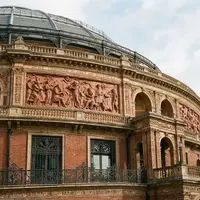
Running around the exterior of the building is a terracotta frieze depicting the Triumph of Arts and Sciences. It is one of the largest examples of terracotta decoration in the world, stretching for over 800 feet. The frieze was designed by a group of artists and shows figures representing music, sculpture, painting, architecture, and other disciplines.
Above the frieze, a mosaic inscription around the top of the building reads "This Hall was erected for the advancement of the Arts and Sciences and works of industry of all nations in fulfilment of the intention of Albert Prince Consort." It is a statement of purpose that the hall has honoured for over 150 years.
A Living Landmark
The Royal Albert Hall is not a museum or a monument. It is a working venue that earns its keep through an ambitious programme of events. It receives no regular public funding and is run as a registered charity. Every performance helps to maintain the building and fund its educational outreach programmes. This commercial vitality is what keeps the hall relevant and alive, a place where history and contemporary culture meet every night of the week.