The Vision of Prince Albert
The story of the Royal Albert Hall begins with Prince Albert, Queen Victoria's husband and one of the great champions of arts and sciences in Victorian Britain. Following the enormous success of the Great Exhibition of 1851, which Albert had championed, he envisioned a permanent cultural quarter in South Kensington. This area would include museums, colleges, and a great hall for public gatherings and performances.
Albert died of typhoid fever on 14 December 1861, aged just 42. He did not live to see his vision fully realised, but the momentum he created carried the project forward. The hall was conceived partly as a memorial to his ambitions and was named the Royal Albert Hall of Arts and Sciences in his honour.
Construction and Design
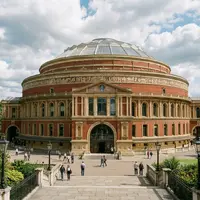
Queen Victoria laid the foundation stone on 20 May 1867, and construction took approximately four years. The architects, Captain Francis Fowke and Major-General Henry Y.D. Scott, drew inspiration from Roman amphitheatres, designing a circular building that could hold large audiences while maintaining good sightlines from every seat.
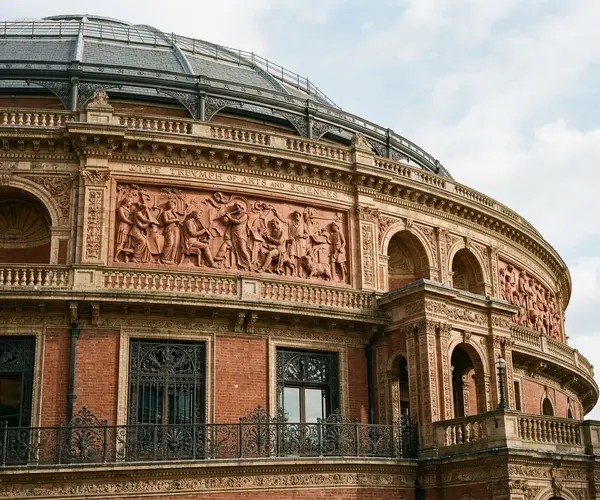
The exterior is clad in red brick and terracotta, materials that were fashionable in the 1860s and which have proved remarkably durable. The terracotta detailing includes a frieze depicting the Triumph of Arts and Sciences, which stretches around the entire circumference of the building. Above it, a mosaic inscription dedicates the hall to its founding purpose.
The most ambitious element of the design was the dome. Spanning 185 feet across, it was constructed from wrought iron and glass, making it one of the largest unsupported domes in the world at the time. It remains an impressive feat of Victorian engineering.
Opening Night
The hall opened on 29 March 1871 to a capacity audience that included Queen Victoria. According to accounts of the evening, the Queen was too overcome with emotion to deliver the opening speech. Instead, the Prince of Wales (the future Edward VII) declared the hall open.
The opening concert revealed a problem that would plague the hall for nearly a century. The domed ceiling created an echo so pronounced that wags joked it was the only venue where a composer could hear his work performed twice. This acoustic issue was not fully resolved until the 1960s, when fibreglass diffusers were suspended from the ceiling.
Changes Through the Decades
While the exterior of the hall looks much as it did in 1871, the interior has been updated and improved many times. The seating has been replaced, the stage has been reconfigured, and modern sound, lighting, and ventilation systems have been installed. A major restoration in the late 1990s and early 2000s addressed structural issues and improved facilities while preserving the character of the original design.
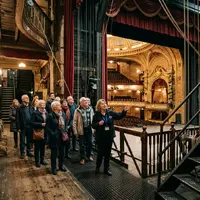
The hall added the Elgar Room, a smaller performance space, and improved its backstage facilities to meet the demands of modern touring productions. These changes were carefully managed to ensure that the Grade I listed building retained its architectural integrity.
Why It Has Lasted
The Royal Albert Hall has survived for over 155 years because it has never stopped evolving. Unlike many grand Victorian buildings that became museums or were demolished, the hall has remained a working venue throughout its history. It has hosted everything from suffragette rallies to rock concerts, from boxing matches to graduation ceremonies. To understand the full scope of what the Royal Albert Hall is and does today, you need to look at its programme of over 390 events per year.
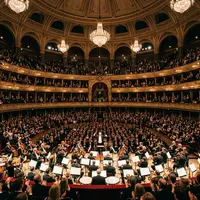
This adaptability is built into its design. The circular auditorium with its flat arena floor can be configured for almost any type of event. The generous backstage spaces can accommodate full orchestras, touring rock bands, and sporting events. It is this flexibility, combined with the building's iconic status and central location, that has kept it relevant across three centuries.