How the Fire Started
The fire at Windsor Castle began at around 11.30am on 20 November 1992 in the Private Chapel in the northeast corner of the Upper Ward. A spotlight being used during restoration work had been placed too close to a curtain, which caught fire. The flames spread rapidly through the void above the chapel ceiling and into the roof space.
Within minutes, the fire had moved into the adjacent St George's Hall and the Grand Reception Room. The Victorian roofing, with its heavy timber beams and lead covering, provided ample fuel. The fire burned for approximately 15 hours before it was brought fully under control.
The Scale of the Damage
By the time the fire was out, 115 rooms had been damaged or destroyed. Nine of the principal State Rooms were gutted, including St George's Hall (the largest room in the castle), the Grand Reception Room, the Crimson Drawing Room, the State Dining Room, and the Private Chapel where the blaze had started.
An area of approximately 9,000 square metres, roughly one-fifth of the castle's total floor area, was affected. The structural damage was immense. Roofs had collapsed, walls were compromised, and centuries of decorative work had been lost.
Remarkably, no one was killed or seriously injured. The castle's art collection also survived largely intact. A renovation project already underway in the area meant that many paintings and furnishings had been removed or covered for protection. Staff, soldiers, and volunteers formed human chains to rescue additional items as the fire spread, saving the vast majority of the castle's movable contents.
The Restoration
The restoration of Windsor Castle ran from 1992 to 1997 and cost 36.5 million pounds. Seventy percent of the funding came from opening Buckingham Palace's State Rooms to the public for the first time, with the remainder from the Royal Collection Trust.
The project faced a fundamental question at the outset. Should the destroyed rooms be rebuilt exactly as they were, or should the restoration take a different approach? In the end, a combination of strategies was adopted.
Rooms Restored to Their Original State
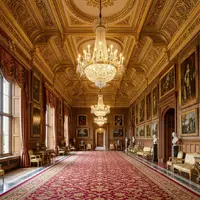
Several rooms, including the Grand Reception Room and the State Dining Room, were painstakingly restored to their pre-fire appearance using historical records, photographs, and surviving fragments. Craftsmen employed traditional techniques to recreate the ornate plasterwork, gilding, and carving that had been lost.
Rooms Given New Designs
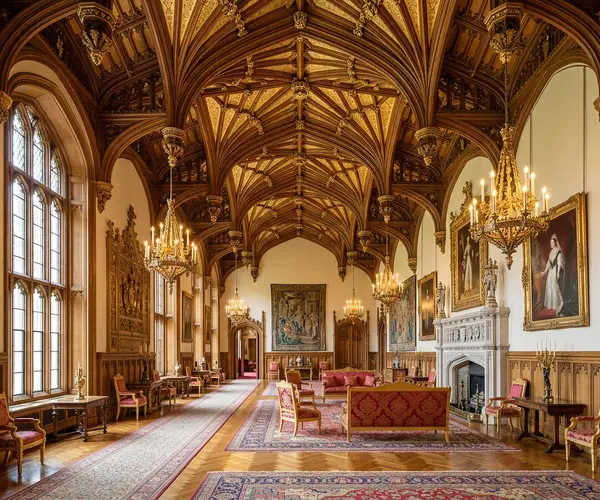
Other spaces were redesigned in a style sympathetic to the castle's Gothic character but not attempting to replicate what had been there before. The Private Chapel was completely reimagined with a modern Gothic design by Giles Downes. St George's Hall received a new hammer-beam oak roof inspired by the medieval original, with carved shields representing the heraldic achievements of the Garter Knights.
The new Lantern Lobby, created in the space where the old chapel had stood, features an octagonal Gothic design with a pointed lantern roof that floods the space with natural light. It has become one of the most admired spaces in the castle.
Legacy of the Fire
The restoration is now widely regarded as a triumph of British craftsmanship and architectural sensitivity. It demonstrated that historic buildings can be rebuilt with a combination of faithful restoration and thoughtful new design without losing their character.
The fire also changed how fire safety is managed at historic royal properties. Detection systems, suppression equipment, and prevention protocols were all significantly upgraded across the Royal Estate following the disaster.
For visitors today, the restored rooms at Windsor Castle show no obvious signs of the devastation of 1992. Our guide to how long you need at Windsor Castle covers the restored State Apartments and other key areas to prioritise during your visit. The quality of the work ensures that the fire, while a significant chapter in the castle's story, did not diminish the building itself.