A Building Like No Other
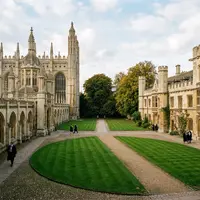
King's College Chapel is the centrepiece of Cambridge University and one of the finest examples of late Gothic architecture in Europe. Standing on King's Parade in the heart of the city, its four corner turrets and enormous windows are visible from across Cambridge. But it is the interior that truly astonishes.
The chapel was founded by King Henry VI in 1446 as part of his vision for King's College. It is the single strongest reason to choose Cambridge if you are weighing up a Cambridge vs Oxford day trip. Henry intended the chapel to be a statement of royal magnificence, and the scale of his ambition is clear in the dimensions. The building is 88 metres long, 12 metres wide and 24 metres tall to the top of the vault. It is essentially a single vast room, uninterrupted by aisles or pillars.
The Fan-Vaulted Ceiling
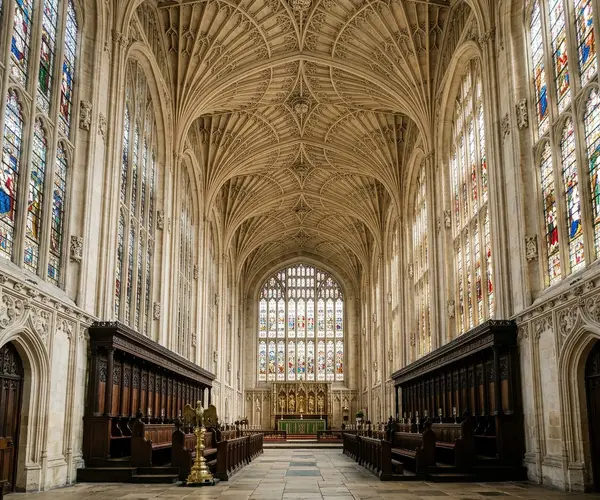
The ceiling is the chapel's most celebrated feature. Completed between 1512 and 1515 under the master mason John Wastell, the fan vault spans the entire width of the chapel without any supporting columns. The stone ribs fan out from the walls in symmetrical patterns, creating an effect that looks almost organic, like the inside of a shell or a forest canopy.
The engineering behind the vault is remarkable. The weight of the stone ceiling is carried by external buttresses that are largely hidden from view inside the building. This allows the interior walls to be filled almost entirely with glass, flooding the chapel with light. The result is a space that feels both massive and weightless, a combination that has astonished visitors for five centuries.
The Stained Glass Windows
The chapel contains 26 large stained glass windows, most of which date from the early 16th century. They depict scenes from the Old and New Testaments and were commissioned by Henry VIII. The windows are among the finest examples of Renaissance glass in England and fill the chapel with coloured light that shifts and changes throughout the day.
The east window, above the altar, is the largest and shows the Crucifixion. The side windows present a typological programme, pairing Old Testament scenes with their New Testament counterparts. Together, the windows form one of the most complete and best-preserved sets of early 16th-century glass in the country.
The Christmas Eve Service
King's College Chapel is perhaps best known for its annual Festival of Nine Lessons and Carols, held on Christmas Eve. The service was first held in 1918 and has been broadcast live on BBC Radio since 1928. It is now listened to by millions of people around the world and has become one of the defining sounds of Christmas in Britain.
The service begins with a solo treble voice singing the first verse of Once in Royal David's City, a moment that is broadcast without the singer knowing in advance whether they will be the one chosen. The combination of the music, the candlelit interior and the extraordinary acoustic of the fan vault makes this one of the most atmospheric services in the country.
Rubens and the Organ Screen
Behind the altar hangs The Adoration of the Magi by Peter Paul Rubens, painted in 1634 and given to the college in 1961. The painting fits the scale of the chapel beautifully, though purists occasionally debate whether a Baroque painting belongs in a Gothic building.
The oak organ screen that divides the chapel roughly in half dates from the 1530s and is one of the finest examples of early Renaissance woodwork in England. It was installed on the orders of Henry VIII, and his initials and those of Anne Boleyn are carved into the woodwork, a detail that dates it precisely to before her execution in 1536.
Visiting the Chapel
The chapel is open to visitors for most of the year, with an entry fee that includes access to the college grounds. During term time, the chapel is used for regular services and may be closed to visitors at certain times. Evensong services, held several times a week during term, are free to attend and offer a chance to hear the world-famous choir sing in the building they were founded to serve.