Exploring Space
The Exploring Space gallery on the ground floor of the Science Museum is one of the most popular rooms in the building. It contains real spacecraft, including a replica of the Eagle lander, rockets, satellites and spacesuits. The gallery traces the history of space exploration from early rocketry through to modern missions and gives a sense of the engineering challenges involved in leaving the Earth's atmosphere.
Making the Modern World
Also on the ground floor, this gallery is essentially a greatest-hits collection of human invention. It holds Stephenson's Rocket, the Apollo 10 command module (which orbited the Moon in 1969), a Ford Model T, early computers and hundreds of other objects that changed the world. The gallery is arranged broadly chronologically, walking you through 250 years of industrial and technological progress.
The Apollo 10 capsule alone is worth the visit. Standing next to an object that actually travelled to the Moon and back is a reminder of how extraordinary the space programme was.
Wonderlab
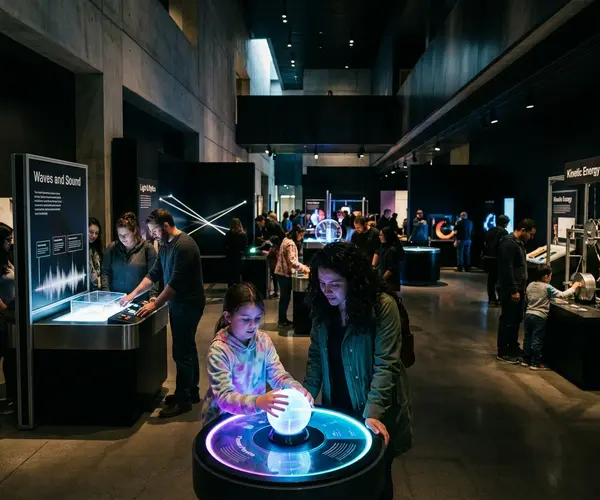
Wonderlab, on the third floor, is the Science Museum's interactive gallery. It is one of the few areas that requires a paid ticket, but it is widely considered worth the cost, particularly for families. The gallery contains over 50 hands-on exhibits and hosts regular live science demonstrations by museum explainers.
Exhibits cover forces, light, sound, electricity and chemistry. Children can create lightning, play with friction, experiment with pulleys and watch live experiments. Adults tend to enjoy it too. The demonstrations are entertaining and genuinely educational.
Information Age
This gallery on the second floor tells the story of communication technology, from the telegraph to the internet. It holds early telephone exchanges, the first transatlantic cable equipment, Enigma machines, early computers and a reconstruction of a 1960s telephone exchange.
The gallery does an excellent job of connecting historical inventions to the technology we use every day. Seeing the physical machinery behind something as abstract as a phone call or an internet connection gives these technologies a weight and presence that digital displays cannot match.
The Mathematics Gallery
Designed by the late architect Zaha Hadid, the Mathematics Gallery on the first floor is as much an architectural experience as a mathematical one. The gallery is arranged around a 1929 Handley Page aircraft suspended from the ceiling, and its flowing, curved layout reflects the mathematical principles it explores.
The gallery covers the history of mathematics and its role in shaping the world, from navigation and trade to architecture and computing. It is more contemplative than some of the other galleries, but the combination of Hadid's design and the carefully chosen objects makes it one of the most distinctive spaces in the museum.
Other Galleries Worth Exploring
The Flight gallery on the third floor holds a Spitfire, a Hurricane and other historic aircraft. The Medicine galleries on the fifth floor trace the history of medical practice from ancient times to the present. The Engineers gallery on the ground floor explores how engineering has solved practical problems throughout history. Five floors offer enough variety that most visitors will find something that captures their attention. To make the most of it, consider planning how long you need at the Science Museum before your visit.