Ancient Origins
Borough Market claims to be one of the oldest food markets in the world, and the evidence supports that claim convincingly. The first written record of a market at or near the site dates to 1014, in a document describing a market at the southern end of London Bridge. But trading in this area almost certainly predates that reference by centuries.
The location makes historical sense. London Bridge was the only crossing of the Thames in London for centuries, and the southern bridgehead naturally became a gathering point for traders bringing goods into the city from Kent, Surrey and the south coast. Archaeological evidence suggests that a market or trading area existed here during the Roman period, when Southwark was a settlement called Londinium's southern suburb.
Medieval Market
By the medieval period, the market at Borough was well established. It grew along Borough High Street, the main road south from London Bridge, and became an important trading hub for grain, livestock, fish and vegetables brought in from the surrounding countryside.
The market caused considerable congestion on the narrow streets, and in 1276 it was temporarily suppressed. It returned, as markets tend to do, and by the Elizabethan era it was firmly established as one of London's principal food markets. The area around it developed its own character, with inns, taverns and theatres (the Globe Theatre was not far away) making Southwark a lively district.
The Move to the Current Site
In 1756, the market was formally relocated from Borough High Street to its current position on a triangle of land bounded by Stoney Street, Bedale Street and Winchester Walk. This move was partly driven by the need to reduce traffic congestion on the main road and partly by the desire to give the market a dedicated, permanent home.
The relocation required an Act of Parliament, and the market was placed under the control of a board of trustees. That governance model continues today, with Borough Market still managed by a charitable trust rather than a private company. This is one of the reasons the market has maintained its character as a genuine food market rather than becoming a purely commercial operation.
Victorian Rebuilding
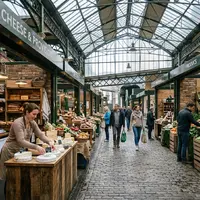
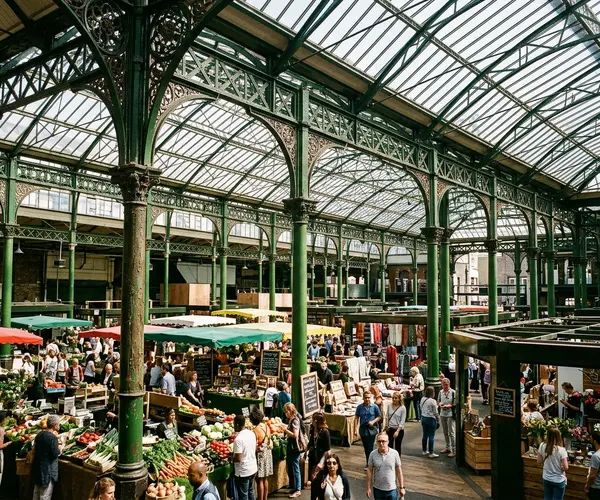
The market buildings you see today are largely Victorian. In the 1860s, the original 18th-century structures were replaced with the iron and glass market halls that give Borough its distinctive appearance. The railway viaduct, which runs directly over part of the market, was built around the same time and created the atmospheric arched spaces that many of the stalls now occupy.
The Floral Hall, originally part of the old Covent Garden flower market, was dismantled and rebuilt at Borough Market in the early 2000s as part of a major renovation project. It now serves as one of the market's most impressive architectural features, though its history connects two of London's great market traditions.
Into the Modern Era
Borough Market went through a difficult period in the mid-20th century as wholesale food distribution moved to larger, more modern facilities elsewhere. By the 1990s the market's future was uncertain. The decision to reinvent it as a retail food market open to the public, beginning with a series of weekend markets in 1998, proved transformative.
Today's Borough Market is the result of that reinvention. It has grown from a struggling wholesale operation into one of London's most celebrated food destinations, attracting both serious cooks and casual visitors. Understanding the difference between visiting on a weekday versus a weekend helps you get the most from a visit to this reinvented market. The fact that it has been a market for over a millennium gives it a continuity and authenticity that newer food markets cannot match.