A King's Seaside Escape
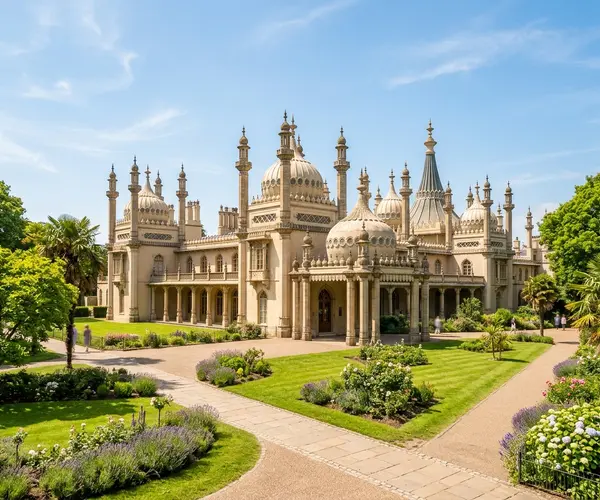
The Royal Pavilion in Brighton is one of the most distinctive buildings in Britain. From the outside, it looks like a Mughal palace that has been transported from India and set down on the Sussex coast. Inside, it is decorated in an elaborate Chinese style, with dragons, pagodas and vast chandeliers filling almost every room. The contrast between these two influences, and the fact that the building sits in an English seaside town, gives the Pavilion its unique and slightly surreal character.
The story begins in 1783, when the Prince of Wales, the future George IV, first visited Brighton. He was drawn by the sea air, which his doctors recommended for his health, and by the town's reputation as a fashionable resort. He initially rented a farmhouse near the Steine, the open area in the centre of town.
From Farmhouse to Palace
In 1787, the prince commissioned Henry Holland to transform the farmhouse into a neoclassical villa. This was a handsome but relatively restrained building. Over the following decades, however, George's ambitions grew steadily more extravagant. The interiors were redecorated in an increasingly elaborate Chinese style, with hand-painted wallpapers, bamboo-effect staircases and furniture imported from the Far East.
The final transformation came between 1815 and 1823, when the architect John Nash redesigned the exterior in the Mughal Indian style that visitors see today. Nash added the iconic onion domes, minarets and pinnacles that make the Pavilion instantly recognisable. The result was a building unlike anything else in the country, a fantasy palace that combined influences from across Asia without any particular concern for architectural accuracy.
The Interiors
The rooms inside the Pavilion are extraordinary. The Banqueting Room features a one-tonne chandelier held by a silvered dragon, surrounded by painted canvases of Chinese scenes. The Music Room has domed ceilings decorated with gilded cockle shells and more dragons. The Great Kitchen, which was one of the most advanced of its era, is fitted out with cast-iron columns disguised as palm trees.
These rooms were designed for entertaining, and George used the Pavilion as a venue for lavish dinners and parties. The scale and intensity of the decoration are deliberately overwhelming, intended to impress guests and project an image of royal magnificence.
Why Brighton
George IV chose Brighton partly for its proximity to London, partly for the sea bathing that was fashionable at the time, and partly because it offered an escape from the formality of the court. The Pavilion was his personal project, a place where he could indulge his tastes without the constraints of the capital. After he became King in 1820, he continued to visit but eventually grew tired of Brighton's increasing popularity and the crowds it attracted.
After George IV
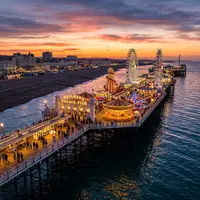
Queen Victoria inherited the Pavilion but disliked both the building and Brighton's lack of privacy. She sold it to the town of Brighton in 1850 and removed much of the furniture to Buckingham Palace and other royal residences. The Pavilion now sits a short walk from Brighton Palace Pier, making it easy to combine both in a single visit. The town has since restored many of the interiors, and some original items have been returned on loan. Today the Pavilion is run as a museum and is Brighton's most visited attraction.