One of the World's Great Libraries
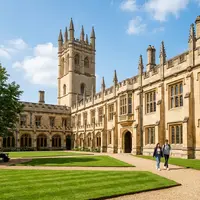
The Bodleian Library is the main research library of Oxford University and one of the oldest libraries in Europe. It was established in 1602 by Sir Thomas Bodley, who restored and restocked a medieval library that had fallen into disrepair. Today the Bodleian holds over 13 million printed items, including books, maps, manuscripts and periodicals, spread across several buildings in the centre of Oxford.
The library is a legal deposit library, meaning it is entitled to receive a copy of every book published in the United Kingdom. Together with the British Library, Cambridge University Library and a handful of others, it has the right to request any new publication. This has helped it grow into one of the most comprehensive collections anywhere in the world.
Duke Humfrey's Library
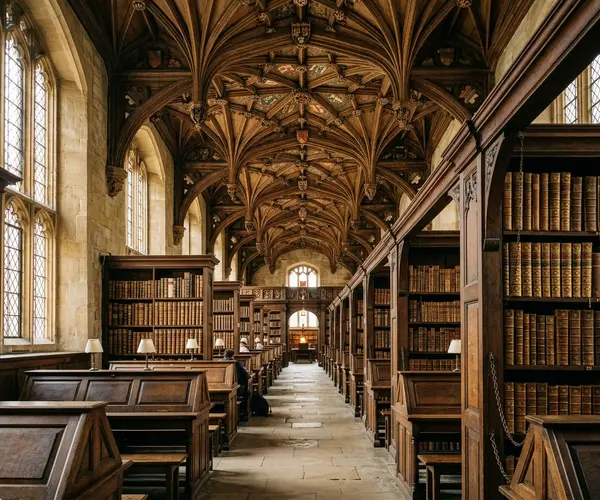
The oldest part of the Bodleian is Duke Humfrey's Library, which dates from 1488. This is a long, atmospheric room lined with dark wooden bookshelves that stretch from floor to ceiling. The books are held behind wire grilles, and the medieval desk arrangement, where readers sat at individual positions with books chained to the shelves, is still visible.
Duke Humfrey's Library was used as the Hogwarts library in the Harry Potter films, and it is easy to see why. The room has a timeless quality, with its painted ceiling, leaded windows and the smell of old books. It remains a working library, and readers still use it for research, sitting in the same space that scholars have used for over five centuries.
The Divinity School
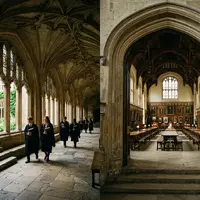
The Divinity School is the oldest purpose-built university building in Oxford, completed in 1488. Its fan-vaulted ceiling is considered one of the finest in England, a masterpiece of late Gothic stonework with intricate carved bosses at the intersections of the ribs. The room was originally used for theological lectures and examinations.
The Divinity School is open to visitors without a guided tour and can be visited independently during opening hours. It was used as the Hogwarts infirmary in the Harry Potter films, and its ceiling is one of the most photographed architectural features in the city. The room is also used for university ceremonies and sometimes for exhibitions.
The Radcliffe Camera
The Radcliffe Camera is perhaps the most famous building in Oxford, a circular domed library that dominates Radcliffe Square. It was built between 1737 and 1749 as a separate library funded by a bequest from Dr John Radcliffe, and it became part of the Bodleian system in 1860. Today it serves as a reading room, primarily for undergraduate students.
The Radcliffe Camera is not always included on standard Bodleian tours, but extended tours that include access to the interior are available at certain times. Even from the outside, the building is stunning, and the view of it framed by the surrounding colleges is one of the defining images of Oxford.
Taking a Tour
Guided tours of the Bodleian run several times a day and must be booked in advance, particularly during the summer months when they sell out quickly. The standard tour includes the Divinity School and Duke Humfrey's Library and lasts about 30 minutes. Extended tours, which may include the Radcliffe Camera and the Gladstone Link underground bookstore, last up to 90 minutes.
The tours provide historical context and point out details that you might otherwise miss, including carved initials, painted ceiling panels and the practical arrangements that allowed the library to function before electricity. If you are planning a day trip, check our guide on how to get to Oxford from London to make the most of your visit. Photography is not always permitted inside the reading rooms, so check when you arrive.
A Living Library
What makes the Bodleian special is that it is not a museum. It is a working library where students and researchers consult rare manuscripts and printed books every day. The Bodleian has never lent a book in its 400-year history, and every reader, including King Charles I during the Civil War, has been required to come to the library to use its collections in person. This tradition gives the building a sense of purpose and continuity that goes beyond its architectural beauty.